
Wheeling-Ohio County Health Department Saw 33% Increase in Use of Needle Exchange Last Year
Trending
WHEELING -- The Wheeling-Ohio County Health Department saw a significant increase in 2024 in participation in the needle exchange program, with a more-than-33% rise in needles being turned in.
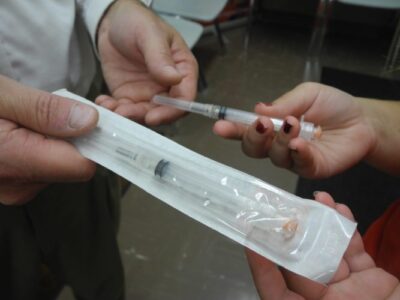
The state-regulated one-for-one program allows drug users to trade their used needles for new, clean ones. This is in an effort to reduce the spread of diseases like HIV and hepatitis, cases of which have generally gone down across the state in recent years but are still prevalent, particularly in communities prone to needle sharing.
Health Administrator Howard Gamble said he feels part of the increase in needles being given in the exchange -- 15,630 in 2024 compared to 11,720 in 2023 -- was due to patients being able to trust providers and feel at ease during the process.
"The service is there and it's not sporadic, it's not questioning and condescending. It is 'here's what we're doing, here's how we can help you, and if you have any questions, we're here,'" Gamble said.
During these visits, doctors can also offer condoms, vaccines, alcohol pads for injection sites, take-home HIV tests and educational materials as needed.
"A lot of it is the clients that we work with become comfortable and also understand that they can get a needle for free and possibly prevent an infectious disease," he said. "It's a walk-in. They meet with our staff very quickly."
Another reason for the growth in exchanges is Project HOPE's mobile health care service, Gamble said. The group of volunteer physicians makes weekly rounds around local communities of unhoused people in their van-turned-doctor's office, allowing them to conduct convenient needle exchanges on site.
Dr. William Mercer of Project HOPE said the increase in needles being exchanged comes back to the impact of access. When the state limited needle exchanges several years ago, removing access, Mercer said their patients were begging for the program to return.
The exchange also allows physicians to build relationships with patients and hold ongoing conversations about things like rehab and treatment.
"There's nothing better than knowing them and them knowing us," Mercer said. "Having that needle exchange brings them to us and then it's 'how are you feeling otherwise, is there anything else we can help with?'"
Project HOPE, Northwood Health Systems and the County Health Department are the three current needle exchange sites in the Wheeling area. The program will need to be evaluated to determine whether another location is necessary to expand access in the future, Gamble said.
Anecdotally, the county health department has not seen any recent local outbreaks of HIV or hepatitis, which are of utmost concern for providers, Gamble said.
"Those can cause a tremendous burden upon our healthcare system as well as can lead to higher rates of morbidity and mortality," he said.
However, there are still cases out there and it can be difficult in general to draw correlations between the needle program data and disease rates, as these illnesses can also be spread through other means, like the exchange of bodily fluids.
In addition to clean needles, the participating sites offer Narcan and fentanyl test strips to combat drug overdoses, another issue that plagues communities struggling with addiction.
Narcan distribution is much more impactful than the needle exchange in specifically the reduction of overdoses, Gamble said, which the state as a whole has seen decrease in 2024.
Though there were 125 units of Narcan given out at needle exchange sites in 2024, most Narcan is distributed through programs and individuals outside of the needle exchange, Gamble said.