
Trending
WHEELING -- Math scores for last year's 7th grade students in Ohio County exceeded what they achieved as 6th grade students the year before on the West Virginia General Summative Assessment, and that's a move in the right direction, according to school officials.
Results from the 2023-2024 standardized testing in West Virginia were made public this week, and Ohio County Schools administrators were particularly pleased with the scores - especially as they pertained to middle school math proficiency.
Education officials up and down the Northern Panhandle are analyzing this year's assessment scores, feeling good about the progress their students have made in some areas while trying to figure out how to harness that energy to shore up subjects in which students declined.
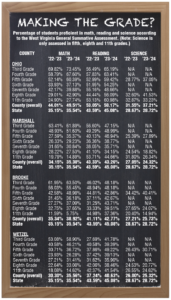
In Ohio County, cumulative math scores for sixth graders on the 2022-2023 indicated overall math proficiency for the county's sixth graders at 33.9%. The latest scores show the same students as 7th graders improving their math proficiency by 6% up to 39.9%.
"That generally doesn't happen. The percent proficient generally goes down each year, if you look from third grade to 11th grade," explained Walt Saunders, director of assessment and federal programs for Ohio County Schools. "Our sixth graders scored higher as seventh graders, and our seventh graders (from the previous year) scored higher as eighth graders.
"It's a good thing. It shows we've mastered more of the standards at each grade level."
He suspects declines typically occur at the middle school level as students move away from having one teacher in elementary school to having six teachers each day in middle schools. Saunders attributed the improvement to first identifying from test results where students were lagging -- which was in geometry, probability and statistics skills.
"That kind of jumps at you off the page," he said. "So we needed to expose our students to more problems in those areas so they can better learn that information.
"When I say a seventh-grade student scored better in seventh grade than they did in sixth grade, that's proof they mastered those sixth grade standards and were ready for seventh grade material. We're doing less remediation, and we're doing more exposure to geometry, probability and statistics."
The county's educators had met together last year to discuss why students weren't retaining information in geometry and statistics. They determined it was because those topics were taught near the end of the school year.
"We found that because it came close to the end of the year, they weren't getting as much exposure to those types of problems as the other standards," explained JoJo Shay, innovation coordinator for Ohio County Schools.
Teachers made changes in the order in which they presented geometry and statistics, or made an effort to discuss them earlier in the year, she explained.
"And as a teacher, if I spend less time remediating (reteaching) seventh-grade standards, I have more time to teach eighth-grade standards," Saunders added. "By helping students to perform better, we're creating time for the next teacher."
Saunders noted the math intervention seems to be successful
"We want to thank our students, their parents and guardians," he continued. "They are the ones who help drive it. When they put a priority on it, it makes our job a lot easier."
Shay added much time and effort has been spent over the last three years to create spaces where teachers can get together and discuss the challenges they see in the classroom.
"They have conversations about individual students, and about specific standards and whether we are struggling with them at the county level or in specific buildings," she continued. "I think they've begun to work together more."
The sixth grade math teachers have even begun to communicate with each other via an email chain to share information, and an eighth grade chain "is coming together," according to Saunders.
Additional math teachers were also hired for Wheeling Middle School and the Warwood School, which needed the most attention.
Shay hosted seminars for language arts and math teachers over the summer, and they reviewed the testing data before it was made public. School districts typically start to receive test results information soon after the students have completed testing in March, according to Saunders.
"We're allowed to use the data before it goes public," he said. "We've been in it all year. We just can't make it public until the state makes it public. So in the summer, we're already pointing out what changes we're going to make for the coming year. And it's not JoJo and I pointing them out. It's the teachers pointing them out.
"We started with a crisis in middle school math," Saunders continued. "And then we added resources to address that, and we're moving through that."
Last year, a similar focus was placed on improving math scores for older students at Wheeling Park High School, and the result was a 3% improvement, according to Saunders.
"We're hoping to see even bigger gains this year," he continued.
High school students don't take the GSA, but instead are required to take the Scholastic Aptitude Test (SAT) during their junior year to measure proficiency.
Saunders was asked what the school district could do to get students more interested in achieving higher proficiency on standardized testing.
"At the high school, motivation is the SAT and you can qualify for the Promise scholarship by taking a free SAT we provide," he responded. "That's motivation for some students who are going off to college.
"We're now paying for all 10th grade students to take the (preliminary) SAT. That way we have actionable data for those students when they go into 11th grade. We've already been looking at that data this summer so that we can improve their SAT scores."
Ohio County Schools wants more students to qualify for the Promise scholarship because it can remove a large financial burden from families, he added.
Another motivator for high school students is the Stifel Program, which provides a cash incentive to the best students at each grade level. A student's ability to win the money is based not just on grade point average but performance on the GSA, according to Saunders.
Parents have come to understand their child needs an outstanding performance on the GSA to win the Stifel dollars, and many are now pushing them toward it, he continued.
"We've had some good parental input, we would like more. I think that's the next level," Saunders said. "I think we're getting better at that."
Reading scores traditionally have outperformed math scores in Ohio County, and only "a few fine tweaks" are needed in that curriculum, according to Saunders.
"We're still showing growth there, but the real concentration was math," he said.
Overall scores in the county showed reading proficiency for all levels increasing from 53% to 58%, and math scores from 44% to 50%. Across the state, proficiency scores remained flat. Reading scores moved up from 44% proficiency to 45%, and math scores from 35% to 36%.
Ohio County Schools finished among the top five in the state in both math and reading proficiency, according to school officials.
Marshall County
In Marshall County, 35% of students met or exceeded standards in math, 43% met reading standards and 24% were considered proficient in science. Only math proficiency improved by 1% from last year, while reading proficiency remained stagnant at 43% and science proficiency decreased by 3%.
Statewide, West Virginia as a whole sees 36% of students meeting or exceeding standards in math, 45% in reading and 29% in science, according to this year's assessment.
Marshall County students' proficiency in math and reading reached their highest levels in third grade at 62% and 57%, respectively.
Math proficiency decreased steadily from third grade to the lowest of 29% in sixth grade, slightly increasing to 31% in seventh grade. Math proficiency reached its lowest rate of 15% in 11th grade.
Reading proficiency decreased steadily from third grade to the lowest level of 34% in eighth grade. Reading proficiency then increased to 45% in 11th grade.
In a written statement released Friday, Superintendent Shelby Haines said Marshall County Schools has been "working on analyzing this data all summer with principals and faculty."
"We have identified our areas of strength and weakness and each school will be working with their staff, starting today, to ensure high-quality targeted instruction," Haines said. "MCS will also work to review test scores with the board members during the next two board meetings."
Brooke County
Scores in Brooke County Schools held fairly steady, with language arts scores increasing slightly from 44% proficiency to 45% proficiency, and math scores flat at 29%.
Brooke High School, however, showed significant drops from last year. Reading scores dropped from 45% to 37% proficiency, and math scores from just 12% to a dismal 6%.
Superintendent Jeffrey Crook acknowledged the overall math score would have been considerably higher if the high school students would have achieved at least an additional 10 percentage points.
"Our efforts have helped the students in the lower grades," Crook said. "But with the SAT, we are still trying to find the key. We're working on ways to get kids motivated with incentives and different things."
Like Ohio County Schools, Brooke County Schools has contracted with the Khan Academy to provide online help for students in math that need it.
"I have been in the classes, and I've seen what the teachers are doing. The results are still disappointing," Crook said. "With the teachers we have and resources they are implementing, I think we're going to see some improvement.
"It's been a struggle. It cycles with different classes. They have to work hard, they have to want to do well."
He said about 45% of Brooke County High School students go on to college. The remainder of them see no incentive to do well on the GSA.
"We have to get more creative in providing support," Crook continued. "We're trying."
Wetzel County
Wetzel County reported 36% of its students proficient in math, 41% in reading and 25% in science. This is an increase from the 30% and 37% proficiencies in math and reading, respectively, reported the previous year and a slight decrease in science proficiency of 1% reported the previous year.
Testing Coordinator Paul Huston attributed the county's proficiency scores being equal to or below statewide proficiency to the county's smaller size and teacher-staffing problems.
Huston noted that in larger high schools in the state, such as Wheeling Park High School or North Marion High School, teachers are devoted to teaching a single subject, while Wetzel County high school teachers often must teach multiple subjects.
"When you're just prepping for one subject as a teacher, of course, you can do a better job covering that course," Huston said. "We also struggle to staff our four high schools and find certified teachers."
Huston attributed the proficiency increases in math and reading from Wetzel County's proficiency scores last year to "more intense looks at not just state test data." He said elementary schools use benchmark data to assess progress, while high schools use PSAT scores from the spring and fall.
"We discuss the data regularly, and this year, we're going to step it up another notch when we look at data," Huston said. "We're not just going to look at those benchmark data and our state data. We will look at attendance data and our Student Assistance Teams data, which will help kids that may need assistance in academics, attendance or behavior."
Huston said he was "stressing" to principals and teachers that their instructions should be based on benchmark data. He added instruction changes should be based on benchmark data to "better meet the needs of the kids."
Huston noted one of the "crucial things" he has observed from analyzing benchmark data is the district needs to provide more attention to kids who are "coming to school with issues that prevent learning from happening."
"A lot of kids in our district are coming to school with issues, and if you're struggling with lots of issues, whether that be where your meals are coming from or where you're going home to at night, those kinds of factors have an impact," Huston said. "If you have those issues, learning is not happening."
One of the steps Wetzel County Schools will take this year to address the needs of struggling children in the school system to improve test scores is a countywide book study for teachers and instructional aids on "Turning High-Poverty Schools into High-Performing Schools" by Kathleen M. Budge and William H. Parrett.
Another step is implementing "countywide teachers" in subjects to facilitate communication between teachers in the county's four high schools. Countywide Microsoft Teams virtual meetings will also be conducted between high school teachers to discuss results from benchmark assessments performed at the schools every nine weeks.
"These meetings will get all these schools talking to each other about benchmarks, what content they're teaching and how they are pacing curriculum," Huston said. "They will allow teachers to talk about what their kids are doing and how well they did on this or that assessment. We want everyone on the same page so everyone knows what each other's doing and how we can improve."
Huston noted that another step in the county's plan to improve scores would be focusing on "standards-based learning." He said "all students" need to reach the standards for their grade level.
"We've realized that some kids are in sixth-grade but are behind on their reading and might function better on a third-grade level," Huston said. "We want those kids to hear and see the vocabulary words in that third-grade standard because often they don't get that. If students don't hear or meet those standards, they will lack the vocabulary to succeed in the future."