
Proposed Ohio County Schools Cellphone Policy Now Before Principals for Comment
Trending
WHEELING - A policy that would eliminate cellphone during instruction at Wheeling Park High School - and officially ban their use in middle schools - is now going before principals for comment.
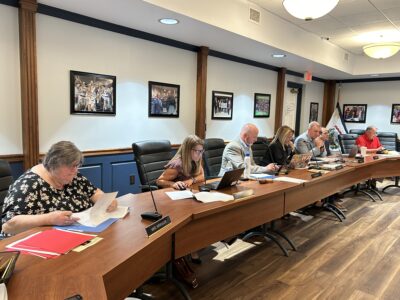
The Ohio County Board of Education convened for its first meeting of the term Monday night. New members Bernie Albertini and Anne Hercules were seated at the table, alongside board president David Croft and members Molly Aderholt and Andy Garber.
A copy of the proposed cellphone policy - which was crafted by Croft - was distributed to each of the members.
"We had an opportunity to add input, and I know (WPHS Principal Meredith Dailer) and her team also had input," Superintendent Kim Miller said. "Our ask this evening is for the board to take this as their first look at the policy, and we're hoping at the next board meeting we will be able to put it into practice."
The policy would permit high school students to keep their cellphones with them throughout the day, but to also prohibit their use during class time.
The use of cellphones at the middle school level is prohibited in the school district, and the policy would put that in writing, Miller explained.
Croft explained what is required of such policies prior to adoption by the board. The policy must be crafted with the collaborative help of all stakeholders, then introduced at an open board meeting - which it was Monday night.
Principals must now review the policy and provide comment. After this, faculty senates and local school improvement councils will weigh in on the measure, as will the school district policy review committee that is being established, according to Croft. The policy then must be displayed for public comment, and after this any revisions will be made.
"There is a process for this," he explained. Suggestions will be considered, he added.
Aderholt said she recommends amending the policy to reflect the difference in cellphone use at the high school - where it would be prohibited only during instruction time - and at the middle schools, where cellphone use is not allowed.
She also wondered if middle school cellphone could be changed to allow use before school and after the school day ends.
"I don't think we've had the middle schools weigh in," Miller said. "It didn't seem to be a middle school issue. I don't recall having principal or teacher input. Do we need to get input from those grade levels? Or do we leave it out and add it to the policy?"
Croft said that, as part of the process, middle school principals would get the opportunity to comment on the policy before final adoption.
"My impression was that people wanted the kids to have their cellphones between classes and at lunchtime at the high school," Aderholt said. "I don't think that's the case at the middle schools, so I would expect those principals would want to maintain (having no cellphone use permitted.)"
Board member Andy Garber, a retired middle school principal, noted he liked the idea of having the middle school principals weigh in on the issue.
"That (cellphone use) was one of our big challenges," he said. "To find a niche for the kids (to place their phones) was difficult. By having them just put their phones away, that takes away some of the anxiety for teachers."
Garber added he would be interested in hearing what the middle school principals think.
Miller said high school administrators were not in favor of putting the consequences for violations into the cellphone policy.
Croft asked how she envisioned violations being handled. Miller responded it would be handled by the teacher first, then the teacher goes to administration.
"They wanted violations to be a (student) handbook piece, but not necessarily in the policy," she said.
The discussion was they wanted to have the flexibility to change consequences if violations continued without having the overall policy readdressed by the board.
"I still think there needs to be a reference in this policy to where the violations are located," Croft said. "Otherwise we have a policy that doesn't address violations. There's a miss in my mind.
"If there were a speeding rule that says (don't drive over 55 miles an hour), and there is no consequence, I'm going to drive fast. People tend to connect consequences to the rules."
Croft noted he was fine with having the consequences spelled out in the student handbook provided that was referenced in the policy.
The board is next scheduled to meet at 6 p.m. on July 22 at the board office, 2203 National Road, Elm Grove.