
Agencies Working With Wheeling’s Homeless Gather for Summit
Trending
WHEELING - Dozens of representatives from area agencies that are involved in one form or another with Wheeling's homeless population came together Wednesday and spent hours brainstorming ideas to help better address the community’s situation with unhoused individuals.
From executive directors of large social service agencies to boots-on-the-ground advocates who regularly visit the homeless encampment, the coalition that met Wednesday afternoon at First Presbyterian Church in Wheeling showed a collective eagerness to work collaboratively with one another and tackle homeless issues as a united front.
All of the represented agencies provide some type of services for the homeless in Wheeling, and many of them provide a myriad of other services to additional segments of the community, as well.
"We want to create a plan that is collaborative and supportive among all of our agencies," said Susie Nelson, executive director for the Community Foundation for the Ohio Valley, which helped coordinate the summit. "We’re not going to achieve everything that we want to achieve after just one meeting. It may take two or three meetings to develop a clear plan. But this is a good first step."
Nelson noted that the Community Foundation was known primarily for its coordination of grant-funded, community-based programs. However, another function of the agency was to help bring entities together and facilitate collaborative planning.
"One of roles -- we convene groups together, as a part of what Community Foundations do," she said, indicating that her role was to coordinate the session in a productive and organized manner. "I told them I am not an expert in the homeless base."
Nelson added that this team meeting had been in the works for several months. Claudia Raymer of the Ohio County Family Resource Network first contacted Nelson to facilitate the meeting, and eventually the first summit came together.
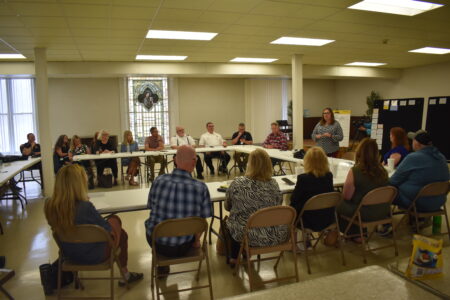
Representatives from dozens of area agencies that work with the local homeless population gathered together on Wednesday for what promised to be the first of a series of summits in which plans of action are addressed to tackle issues related to Wheeling’s unhoused community. (Photo by Eric Ayres)
Representatives present at the meeting first introduced themselves, and each described what their organization does - specifically in connection with the local homeless population. The stakeholders outlined the services they provide as well as their limitations.
Many of the agencies are bound by rules and regulations that have them serving a certain demographic. Some agencies do offer homeless shelter beds, but most have specific guidelines that prevent them from being what is considered a "low barrier shelter," or one that takes unhoused individuals with no questions asked. Some have age restrictions, require identification, are for males only or females only, require individuals to be sober, are for veterans only, or have certain restrictions as specified by federal grants that are utilized to help operate their programming.
Lt. John Lawrence of the Salvation Army of Wheeling said that among their services, they offer a 35-bed shelter for men in a newly renovated facility that operates 365 days a year. Usually, there are only five to seven men in there, he said. But there are rules - they cannot be intoxicated, for safety reasons. They also have to have some form of identification. Acceptable forms include a note on letter head from other agencies vouching for who a person is.
"We are not a low-barrier shelter," Lawrence said. "But we do not have a set maximum number of days you’re allowed to be there at all - we don’t do that. We stopped that when I got there, because if a person is working towards goals, and you see that they’re putting forth that effort, then why limit them on 21 days? Because let’s face it - it took them a lot longer than 21 days to get into the situation they’re in, it’s going to take a lot longer to get out of it. So we want them to be able to build up to that point."
Wednesday’s three-hour gathering included representatives of the Community Foundation for the Ohio Valley, Ohio County Family Resource Network, The Life Hub, Wheeling Health Right, Youth Services System Inc., Northwood Health Systems, Street Moms, House of Hagar, Mother Jones Center for Resilient Community, Soup Kitchen Greater Wheeling, Greater Wheeling Coalition for the Homeless, Catholic Charities Neighborhood Center, Wheeling Human Rights Commission, First Choice Services, Wheeling Police Department, Northern Panhandle Continuum of Care, YWCA of Wheeling, Project Hope, American Public Health Association, Wheeling Health Department, Catholic Charities West Virginia, The Salvation Army, Wheeling Fire Department, the Northern Panhandle Harm Reduction and Recovery Alliance, the City of Wheeling and Helping Heroes.
A number of the organizations regularly work with homeless individuals living at the camp along the maintenance trail in East Wheeling where the city manager’s office has allowed an exemption to the camping ban that went into effect this year. It is not a "managed camp," that the city has agreed to allow, and organizations are working together to try to get closer to a situation that truly is managed by the entities that are involved.
"We want to work with all agencies," said Derek Lantz of the Catholic Charities Neighborhood Center. "We’re really open to all the help we can get. We really want to make this work. As far as the exempted location out on the trail, we’ve tried to make that as inviting and as welcoming as possible for our neighbors because we know that transition was kind of chaotic."
Lantz and others noted that they have been trying to encourage the residents of the exempted camp to "take ownership" in it and pitch in to help maintain it. He also said they want to continue working to help them develop life skills, get housing and become employed.
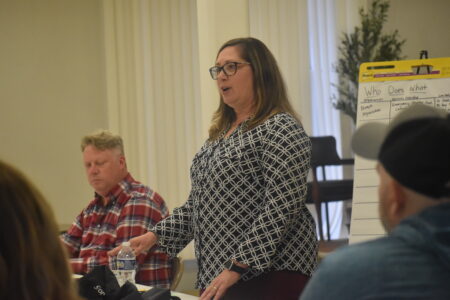
Susie Nelson, executive director for the Community Foundation for the Ohio Valley, helped facilitate the gathering Wednesday of area service organizations and agencies that help the homeless population. (Photo by Eric Ayres)
"We just want to help folks, starting from the ground up," Lantz said. "We know our neighbors have hit rock bottom."
Representing the Wheeling Police Department was Deputy Chief Josh Sanders, who noted that safety and security was a primary service they provide to the homeless population.
"We want all of our community members to feel safe and secure wherever they live - wherever they’re putting their heads down," Sanders said. "The police are not a barrier - we are here to help, just like all of you are, and we want to work and be a team with everybody else."
Sanders said the police department has peer support specialists embedded in their office now - something he said is a key part of the future of community police work. Officers are also involved in crisis intervention training so that they can respond appropriately to calls involving the homeless, individuals suffering from active drug addiction and other situation.
The police department’s barriers not only include staffing issues, but also involve "inclusion and communication," Sanders said.
"We don’t know if anyone is unsafe or in harm’s way if we’re not included in the conversation," he noted.
Mark Phillips, president and CEO of Catholic Charities West Virginia, said collaborative meetings like the one held in Wheeling on Wednesday were taking place all over the state in light of the widespread crisis of homelessness.
"This is not the only place we’re having conversations like this," Phillips said. "We’re having conversations like this in Parkersburg, Charleston and Morgantown. This is the group that’s most involved and committed to working together, so I appreciate everybody’s involvement."
Following introductions, the group met privately to discuss specific concerns, needs, action items and potential steps to be taken. Another meeting is expected to take place tentatively in one month, with other meetings likely in the future.
"I think it was a good jumping off point for all of the agencies involved to try to get a plan of action moving forward," Wheeling Fire Chief Jim Blazier said after the meeting.
"I’m anxious to see how we progress in meeting the needs of the homeless population," said Katie Hughes, housing liaison for the City of Wheeling and lead agency coordinator for the Northern Panhandle Continuum of Care. "There’s a lot of work to be done, but I think that we have a lot of potential. Our agencies are eager to do what they can, and I think our city is eager to support the agencies, as well."
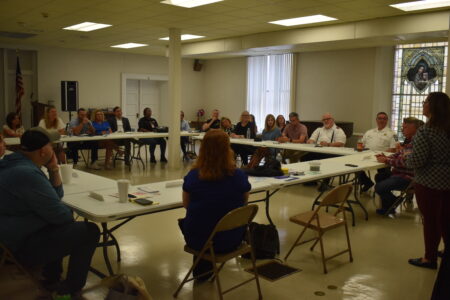
Representatives from dozens of area agencies that work with the local homeless population gathered together on Wednesday for what promised to be the first of a series of summits in which plans of action are addressed to tackle issues related to Wheeling’s unhoused community. (Photo by Eric Ayres)
Collaboration and compassion is a key to move forward in addressing issues related to the local homeless population, according to Kate Marshall, director of the Mother Jones Center for Resilient Community and House of Hagar.
"I think it was an excellent first step," Marshall said following Wednesday’s session. "I think that working collectively, we can put the passion that is in all of our hearts - along with our resources and planning - to come up with something that is actually going to be sustainable and support our unhoused friends in a more proficient and better way than we currently are."
Marshall said this effort will take time to develop, but it is a hopeful one with all parties rowing in the same direction.
"This is definitely going to be an unfolding process of collectively bringing our hearts and minds and resources to the table, identifying the needs and then really reviewing how we can make a way forward that is going to be sustainable," she said.