
Wheeling City Council Approves $100,000 in COVID Aid for Life Hub
 Eric Ayres
 Trending
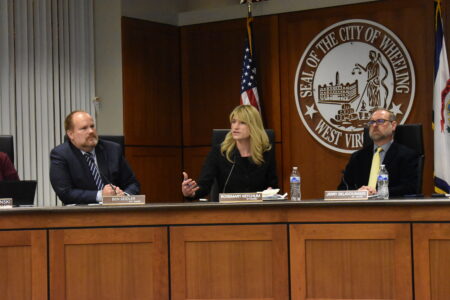
WHEELING -- After a lengthy debate over the issue Tuesday, members of Wheeling City Council voted to provide $100,000 in federal pandemic relief funding for The Life Hub's plans to move forward with a low-barrier homeless shelter downtown.
The issue has been met over the past several months with a full spectrum of opinions and viewpoints among members of council. The concept of The Life Hub is to provide an array of wrap-around support services at a single location and to ultimately provide a year-round shelter available for homeless individuals who fall through the cracks and cannot be sheltered because of other services' eligibility requirements.
A location at 35-16th St. -- the former First English Lutheran Church -- has been secured for The Life Hub, which is set to open the winter shelter for homeless individuals soon. Long-term plans call for the construction of a shelter on the property.
On Tuesday night, members of Wheeling City Council addressed the controversial issue, but ultimately voted 6-1 to provide the money through the city's remaining pool of American Rescue Plan Act funding.
Councilman Jerry Sklavounakis voted against the measure, and provided a detailed explanation why. Mayor Glenn Elliott and Councilors Ben Seidler and Rosemary Ketchum spoke in favor of supporting the ARPA money award for The Life Hub. Councilman Dave Palmer voted in favor of the allocation, but did not comment. Councilman Ty Thorngate expressed reservations about the award, but voted in favor of it. Vice Mayor Chad Thalman has also indicated a lukewarm perception about approaches being taken to address homeless issues in the city, but he also supported the legislation.
"I truly appreciate everything that the members of The Life Hub have done and everything that the supporters of this are pushing, but I'm not going to be voting for this," Sklavounakis said. "The reason why is that I'm very concerned about the unintended consequences of what could possibly happen."
The city two years ago was divided when a slim majority voted to create the position of Homeless Liaison - a post held by Melissa Adams, who helped develop The Life Hub approach to addressing homelessness. Despite not yet reaching its goal of housing a year-round low barrier shelter, The Life Hub is up and running as an independent nonprofit organization with involvement of several local service agencies.
The Homeless Liaison position was intended to be somewhat of a pilot position, to allow city leaders to see how progress was being made on the homeless issues and to allow the next Wheeling City Council that takes office in July 2024 to decide whether or not to continue funding the full-time job.
Sklavounakis explained that when the city created the Homeless Liaison position, the focus was to become "functional zero," which is defined as a dynamic milestone that indicates a community has solved homelessness for a population. A goal was also to coordinate and facility collaboration with existing nonprofits that have been providing services to the homeless community.
While several entities and nonprofits have joined efforts of the Homeless Liaison and The Life Hub, not all have jumped on board.
"The unintended consequence of creating a brand new nonprofit concerns me in a sense that it might suck away the funding of all the long-standing nonprofits," Sklavounakis said.
Sklavounakis said he does not support establishing a low-barrier shelter in the middle of the city.
"The National Alliance to End Homelessness describes a low-barrier shelter as immediate and easy access to a shelter by lowering barriers to entry and staying open 24-7," he said. "It eliminates sobriety, income requirements and other policies that might make it difficult to enter a shelter."
If someone is drunk or high on drugs, they are allowed to enter, Sklavounakis said.
"That causes problems for other people," he noted, adding that someone recently from the southern part of West Virginia was arrested for failure to register as a sex offender. "He was living in one of our homeless encampments in this city, sort of hiding out."
Yet another concern is "if you build it, will they come?" Sklavounakis said, noting that another criminal defendant from the homeless population was originally from Michigan.
A last concern by the councilman was the fact that The Life Hub has a lack of funding.
"I do not in any way, shape or form question the motives behind this. I know that it's pure and it's good. I just don't think that we're at the point right now that I can vote to support this," he said.
Ketchum said the notion that The Life Hub may attract homeless people to Wheeling if it is established needs to be reconsidered because homeless people "are already here." She said she understood concerns that a low-barrier shelter may harbor a homeless person who is high on drugs or a sex offender, but noted it actually takes them off the streets, out of the public and into a hub of services to help get them on the right track.
"If we turn them away from a shelter, they're just going to go squat -- go do it behind someone's house or break into their sheds or break into their properties," Seidler added. "It's not a solution. This whole entire situation is horrible. Quite frankly, it just sucks. I wish there was a better solution, but I do support this."
Sklavounakis and Thorngate noted that some of the $100,000 in ARPA money should instead go toward a managed camp. However, some city leaders have indicated that the city should not be the entity that manages or funds the managed homeless encampment or encampments when the city's new ban on camping in public goes into effect Jan. 1.
"The 'functional zero' approach, to me, is tied to a low-barrier shelter," Elliott said. "Rules would be enforced, but all it means is that we wouldn't be saying up front that 'you can't get in if you've done this in the past.' All we're going to be saying is 'if you get in, you still have to abide by a set of rules.'"
Elliott said nothing is going to eliminate homelessness.
"We have a lot of ways that people fall through the cracks," he said, adding that The Life Hub meets the strict eligibility requirements for federal ARPA money. "I'm willing to take a chance on this vision. This is a small step. It's going to need a lot more money, but to me the alternative is to just continue the status quo. I think the case is stronger that it's going to work than it is not."
George Smoulder, long-time director of multiple local community organizations, also spoke in favor of the funding award.
Wheeling City Manager Robert Herron noted that the city has met with the Wheeling Police and the Municipal Court on how the implementation of the new camping ban will take place in the coming weeks. Notices will be posted at the entrances of the city about the no-camping code. There will be 14-day notices posted in existing homeless encampments to vacate the camps, and those postings will coincide with the opening of the winter shelter that will become available to them.
"We have put together a fairly comprehensive approach to enforcing that ordinance, and it is our intention to enforce that ordinance, effective Jan. 1," Herron said.