
Too Good To Be True: How Prosecutors Say Jeffrey Morris Swindled Millions on Empty Promises of a New Downtown Wheeling Future
Trending
WHEELING -- It was a story that seemed too good to be true.
Jeffrey Morris, born and raised in Moundsville and educated in Wheeling, traveled the world, from Germany to New York to Southeast Asia to Australia. He returned home to the Ohio Valley with big ideas and a way of presenting them that made people take notice -- and pull out their checkbooks to invest.
He scooped up local landmarks with the promise of returning them to their past heights, creating a buzz around Wheeling. The city wanted to revitalize itself, and Morris seemed like he was ready to take the lead in its redevelopment.
That story seemed too good to be true.
Because it was.
Instead of making good on promises, Morris instead has been accused of peddling lies. What was supposed to be a cornerstone of the Wheeling renaissance instead was, according to federal prosecutors, a chorus of unpaid vendors and employees.
And as debts mounted, prosecutors allege Morris' behavior turned criminal. They claim he kept asking investors for more money to renovate and operate his properties, but instead used much of it to pay off other investors, or for expenses that had nothing to do with his projects. It was, according to prosecutors, a scheme akin to what others around the country have experienced, where new investments are used to repay old investors. Jeffrey Morris, prosecutors believe, took advantage of the good-nature of his investors who wanted nothing more than to see a rebirth of Wheeling.
He played them to the tune of about $7 million, prosecutors allege. And now he's awaiting trial in federal court for wire fraud and tax evasion.
Setting the stage
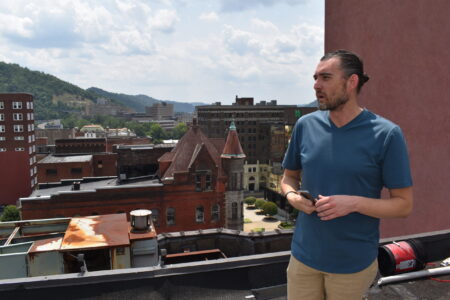
In July 2021, Morris, still relatively new in his return to the region, led local officials on a tour of the McLure Hotel, explaining some of his vision for the structure as he walked from room to room. Through his company Roxby McLure LLC, he would officially buy the hotel less than a month later for nearly $6.3 million. On that July day, he laid out a plan for the extensive renovations that would come in order to bring the downtown Wheeling hotel back to its former glory.
"Over the course of 18 to 24 months, we'll do a floor-by-floor, top-down renovation where we will do a full overhaul of all the HVAC systems, the cosmetics, new bathrooms -- just a full 40-year renovation to bring it into more of a four-star draw to the city," Morris claimed.
They were lofty goals that included a lofty price tag. And that wasn't the only historic Wheeling property that Morris targeted with lofty, perhaps unrealistic, aspirations. He also had bought the Mount Carmel Monastery in the Edgwood neighborhood and the Scottish Rite Cathedral in East Wheeling to renovate, repurpose and help serve as tent poles of a revitalized Wheeling.
Yet while Morris was outlining his McLure plan that July day in 2021, federal prosecutors claim he already had returned to investors for nearly a year asking for more money.
Instead of the renovations he said would come from those funds, prosecutors claim he used that money to pay other investors to whom he owed money, as well as his own expenses unrelated to Roxby.
What prosecutors labeled a "scheme" was presented in detail last month in a 28-count federal indictment against Morris that included 18 counts of wire fraud and 10 counts of tax evasion. He's accused of bilking investors of nearly $7 million and failing to pay to the IRS $252,000 in Medicare and social security taxes he had withheld from employees' paychecks.
The indictment was the final push in what became a swift and precipitous fall for a person who had been lauded throughout Wheeling for his attempts to find new life for many of the city's most historic properties.
William Ihlenfeld, U.S. Attorney for the Northern District of West Virginia, said this wasn't a case of a young, enterprising developer getting in over his head.
"He intentionally defrauded these investors," Ihlenfeld told "MetroNews Talkline" in September. "That was his plan from the beginning."
Morris, when contacted for this story, said he was not in a position to comment at this time due to his pending legal issues.
Big Dreams, Big Purchases
When Jeffrey Morris returned to Wheeling, he immediately made a splash when he announced a project in the Edgwood neighborhood. On Jan. 31, 2020, he purchased the Mount Carmel Monastery for $430,000, with the funds for that purchase coming from investors. The Monastery housed sisters of the Order of the Discalced Carmelites from 1917 to 1974, when a real estate developer bought it and converted it into apartments. Morris wanted to turn the property into a boutique hotel with a restaurant and event space.
Morris made an official pitch to city leaders for the project in early 2020, and had support from a number of neighborhood residents. He promised a venue that not only would renovate the existing structure but also enhance the neighborhood. He proposed a timeline of about two years for his vision to become reality.
No work has been done at the monastery, which Roxby still owns, to date.
Morris would go even bigger with his next major purchase, the Scottish Rite Cathedral in East Wheeling. A Freemason meeting hall, Morris bought that property for $750,000 on Sept. 15, 2020. That money wasn't due until 2025, but the purchase price also included some structural improvements like replacing the boiler heating system and repairing and replacing damaged brick along the roof line.
The Scottish Rite building was one that Morris said held a special place in his heart after he stayed in the building the night he bought it.
"I was like, 'I love this building. I'm never leaving.' I've lived here pretty much ever since and I'll never leave," he told The Intelligencer in February 2022. "I love this building more than any place that I've ever been. It has a heart and soul that I can't duplicate."
Some work was done at the Scottish Rite Cathedral, and several events took place there including a public unveiling that had many locals excited for what the future would hold. In the end, though, as part of Roxby's inability to pay creditors, the Scottish Rite Cathedral reverted back to its original owners following a public auction.
The gem in Roxby's growing empire came next with the purchase of the McLure Hotel on Main Street downtown -- the same hotel that had hosted 11 U.S. presidents, and could serve as a keystone to a revitalized central business district. Morris bought that property for $6.245 million -- about $1.2 million more than its value -- and made about $1.18 million of down payments and fee payments to the McLure's former owner through a land contract.
The funds for all these purchases came from investors -- including Investor 1, so named in the federal indictment, who served as Morris' biggest investor. It was with those investors, federal prosecutors claim, where much of Morris' illegal activity began.
'The Scheme'
Many in Wheeling long had been awaiting a savior to revitalize the city's downtown. Jeffrey Morris, with his youthful energy, boundless optimism and what appeared to be deep pockets, appeared to fit that bill.
But not everyone was buying what Morris was selling. William Ihlenfeld had just finished a term as U.S. Attorney for the Northern District in West Virginia and was serving in the West Virginia Senate when Morris arrived in Wheeling. Ihlenfeld, who returned to lead the U.S. Attorney's office in mid-October of 2021, admitted he was among the skeptics as Morris began buying up property and growing his company so quickly.
"This just doesn't add up," Ihlenfeld said. "How does someone have a payroll with a hundred people on it -- that's what he was saying publicly -- and how does he have a personal assistant who drives him around and makes him coffee in the morning and how does he have a personal chef?
"It just wasn't adding up that he was splurging on all these additional things a startup company typically doesn't have."
Federal prosecutors contend the extravagant expenses were possible in large part because Morris was getting money from investors under the pretense of spending it on renovations and upgrades to the buildings he owned, but then using it for something completely different.
The indictment offers a blow-by-blow account of claims that Morris defrauded investors in a nearly four-year span between October 2019 and September 2023, a timeframe that predates his initial purchase of the Mount Carmel Monastery. That section of the indictment was entitled "The Scheme."
Components of the "scheme," prosecutors allege, included making false promises and statements to investors to gain more money, then doing something other than what was promised.
That included using funds from one investor to make payments to other investors. Morris allegedly used funds invested to renovate one property to pay expenses on another property including payroll. He allegedly used investor funds to pay debts of companies he owned not related to Roxby renovations, pay off credit card transactions not related to Roxby expenditures or pay personal expenses.
The wire fraud accusations in the indictment center around four unnamed investors. The investor identified as Investor 1 in the indictment, from September 2020 to July 2021, gave Morris a total of $2.275 million, according to the indictment, mainly to pay for renovations. Prosecutors claim a large chunk of that money was used to pay other investors.
For instance, prosecutors allege that on April 19, 2021, Investor 1 gave Morris $850,000 to renovate The Monastery. Instead, Morris allegedly used $31,050 of that money to fund a real-time payment to someone else who had invested in The Monastery. He allegedly used another $95,000 to write a check to another investor. Another $43,200 of Investor 1's money allegedly went to another real-time payment to someone else who had invested in The Monastery.
Meanwhile, prosecutors allege Morris would lie to Investor 1 about completing renovation projects and other matters. For instance, he allegedly emailed Investor 1 on Oct. 28, 2020, saying he would sell the investor historic tax credits for the Scottish Rite Cathedral for a value he "expected to be approximately $212,500." On Nov. 8, 2020, Morris allegedly emailed Investor 1 saying the first part of the historic tax credit submission was complete and the second part had been started.
Prosecutors claim neither was true.
In the same email, he also allegedly claimed he signed contracts to refurbish the cathedral's passenger elevator and freight elevator and paid deposits on both. Prosecutors claim neither was true.
Prosecutors also claim Morris bought the McLure Hotel under false pretenses. The indictment alleges that, on May 8, 2021, Morris submitted a proof of funds to the company handling the hotel's auction. He allegedly uploaded to that company's online system a screenshot showing the balance of three accounts totaling around $844,000. The actual balance of those accounts on the submission date was just $48,000 and the total balance of all Roxby-related accounts on that submission date was around $225,000, according to the indictment.
In essence, prosecutors claim, Morris created a financial picture of his company that allowed him to purchase assets so that he could then bilk his investors with renovations that never actually happened, with the money going primarily to pay other investors and support his lifestyle.
Morris' dealings with the other investors were much the same, according to the indictment. He would ask for money for one purpose, pay other investors with most of it and lie about projects completed or financing procured.
Meanwhile, Morris at the same time allegedly was running afoul of the IRS. According to the indictment, over five calendar quarters between April 2022 and April 2023, Morris failed to account for and pay approximately $163,000 in payroll taxes and $89,000 in FICA employer matching taxes. He withheld the taxes from employee paychecks, prosecutors claim, but that money never made it into the government's hands. It's not clear how Morris appropriated the funds.
The overall alleged scheme lasted for years, but it eventually started falling apart.
The Foundation Crumbles
The cracks in the Roxby facade started to show in 2022, and some Roxby employees were among the first to see it. What they weren't seeing, some of them eventually claimed, were their paychecks.
In August 2022, four former Roxby employees -- Haley Steed, Tishawana Terry, Bekah Karelis and Sarel Venter -- each filed civil complaints in Ohio County Magistrate Court for wages they claimed they were owed from Roxby. Terry claimed she was owed $5,724, Steed claimed $4,046 owed, Karelis claimed $5,963.96 owed and Venter claimed $6,929.56 owed.
Crin Joy worked for Roxby from October 2021 to August 2022 in a number of roles -- starting as an assistant and eventually working with project management, IT and communications as well as with entertainment and social media marketing.
"My job description that I wrote was three pages long," she said.
Joy said Roxby's failure to meet payroll started to become a recurring worry for employees.
"It began as being late a few days, to a week, two weeks until I was three pays behind," Joy said. "During this we were often promised it was coming a certain day, however it did not. He would then be avoidant despite saying how available he was to discuss the issue with staff. Pay continued to be late. When I left, I was three pays behind. Jeffrey had sent an email about being paid on a certain day. That didn't happen, and there was no communication from him."
Joy said she is still owed her last pay, which is approximately $1,200.
"That's nothing compared to many other people who are owed (months' worth)," she said.
When lavish parties were taking place and renovations appeared to be moving forward at the properties, people -- including employees -- believed in Roxby's vision for the city of Wheeling. Joy indicated that was because it seemed that Morris was sincerely confident that his ventures would succeed.
"I don't know if he intended for it to happen," she said. "I do believe he considered himself a genius. I think he believed all of this would work, but honestly, he's not that much of a genius, then."
Roxby owed thousands to outside vendors as well. L&L Painting LLC of Glen Dale filed a mechanics lien in June 2022 seeking $67,249 for labor and materials provided on the McLure and the adjacent parking garage.
The next big signal came in an April 2023 legal advertisement in The Intelligencer and Wheeling News-Register announcing a foreclosure sale on the McLure Hotel. A total of $5.3 million was still owed to former McLure owner Frances Garey. Morris said at the time the move by Garey blindsided him.
"It was really upsetting to me, and shocking to see," Morris told our reporter.
A foreclosure sale soon would be announced for the Scottish Rite Cathedral as well. In response, Roxby filed for Chapter 11 bankruptcy, which offered an even clearer look at the debt with which Morris' company was saddled. Roxby owed tens of thousands to some creditors, hundreds of thousands to others.
Medical supply company McKesson was owed $658,434 for medical equipment for one of Morris' other ventures, Roxby Labs. Another medical supply company, Medline, was owed $132,463. California-based Gusto Payroll Services was owed $149,000 for a payroll loan. Roxby owed Ohio County $56,000 in unpaid property taxes on the Scottish Rite Cathedral.
Morris was hopeful that Chapter 11 bankruptcy would allow Roxby time to reorganize and emerge from bankruptcy to continue its work on its properties, yet that hope was short-lived. About two weeks after Roxby initially filed for Chapter 11, U.S. Bankruptcy Judge David L. Bissett dismissed the case.
The reason? Morris had failed to maintain property insurance on both the McLure and the Scottish Rite Cathedral. The Cathedral also had no liability insurance.
David Croft represented the Scottish Rite in that case for law firm Spilman Thomas & Battle. He remembered when he started asking about insurance on the Cathedral.
"There were excuses, like 'Well, there's some holdup in paperwork. I've got it. This is crazy,'" he said. "When we realized it didn't exist and he could not produce it -- and that's actually grounds for default ... we immediately filed the motion to dismiss the bankruptcy."
That dismissal allowed the two buildings to go up for auction. They both returned to their previous owners -- Garey for the McLure and the Freemasons for the Scottish Rite -- via credit bids. As creditors, they bid the amounts that Roxby owed them.
When Garey and the Freemasons got the keys back to their respective properties, they found out just how much work still needed to be done.
"I was called about 10 days ago and was informed that the management company that he had was leaving and that he did not have money for employees to continue operations," Garey said following the McLure's foreclosure auction in June. "So I got on the first plane out here to do this."
Croft said the Freemasons found themselves in the same predicament. They already knew in May that there was no running water or heat in the building.
"When I talked to them to say, 'hey, how much did he put in,' (they said) 'We don't know, but it can't be anything significant.'"
Croft could be counted among the Roxby skeptics. Before Roxby filed for bankruptcy -- "before the wheels fell off," as Croft put it -- Morris had approached some of Croft's high net worth clients.
"And they called me and they're like, hey, he's offering this and he says it's a really good deal," Croft said. "So I email back very politely that, in my opinion, it's not the best transaction to engage in."
That appears to have been wise counsel.
The Indictment
There would be no more deals to be offered from Morris, no more excuses as to why his empire had crumbled, no more reasons why people weren't getting paid, as on Sept. 8, a federal grand jury indicted him on one count of wire fraud. Ihlenfeld said at the time that Morris had planned to travel out of the country. With that charge, he was forced to surrender his passport.
Ihlenfeld said that more charges would be forthcoming. He made good on his word on Sept. 27 with a 28-count indictment. A trial has been set for 9 a.m. Nov. 14 in the federal courthouse in Wheeling before U.S. District Judge John Preston Bailey.
If anything, Croft said, the rise and fall of Morris and Roxby Development can be seen as a cautionary tale for investors. The lesson: never take internally generated documents at face value. Hire people who can do the due diligence to make sure claims are legitimate.
"Take the Ronald Reagan approach to trust, but verify," he said.
Of the spectrum of emotions that people feel about the situation, disappointment sits chief among them. Wheeling is a city trying to revitalize itself. The Downtown Streetscape Project will give main downtown arteries a fresh look. Apartment buildings are rising along Main Street and new small businesses continue to pop up.
Locals were excited at the prospect of someone buying city landmarks and renovating them, making them part of the downtown renaissance. Now they're disappointed in the result.
"It's sad, but there are a lot of good people in Wheeling who are investing their hard earned money," Ihlenfeld said on "Talkline." "They're doing it the right way. They are not trying to take shortcuts or trying to trick anyone. ... A lot of good is happening."
Croft doesn't look at Wheeling solely through the prism of being a local attorney. He's an elected official, a member of the Ohio County Board of Education. He has hopes for Wheeling like so many others. And his worry is that, if another young developer comes along with big ideas, residents will look at him with a jaundiced eye.
"It's going to cast shade on the next project that may be viable," Croft said. "Because they're going to say, 'Oh, you're just another Jeffrey Morris. You're Jeffrey Morris 2.0."
Staff Writer Eric Ayres contributed to this report.