
Trending
GLEN DALE - When a person's addiction has them at their worst, a helping hand can keep them stable and provide the first step on the road to recovery.
BreakThru Medical Withdrawal Management, hosted locally at WVU Medicine Reynolds Memorial Hospital, offers that hand to people in the grips of withdrawal, providing medical support to individuals at risk of injury or death from withdrawal, before starting them down the path to rehabilitation.
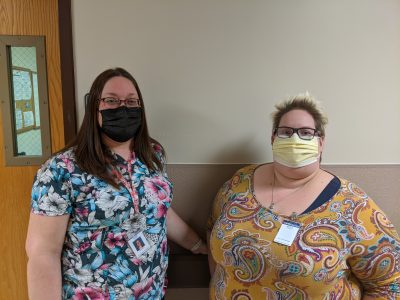
Kayla Straight and Teddi Grim, two continuum of care managers with the program, said BreakThru serves as a midpoint between an addict's low point and treatment.
"The primary focus is just keeping them comfortable," Straight said. "We manage body aches, nausea, vomiting, seizures. We specialize in people who have comorbidities - people who have heart conditions, hepatitis, AIDS, diabetes, who might need a little more medical care while their bodies go through the trauma of detoxing those first couple days, we're here to make sure they stay medically stable."
BreakThru works alongside inpatient care services such as rehab centers, which frequently call on BreakThru to monitor people through the worst of their withdrawals before longer-term treatment can begin.
"It's actually nice for the patients in other facilities, because we don't tap into their behavioral health," Grim said. "It gives them more time at Northwood or another treatment center, and they rely on us as well, because if they have a patient at their crisis center, ... they're medically unstable and they're like, 'You need to be in the care of a physician."
"Then we can get them medically stable and send them back to wherever they wanted to go to begin with for longer treatment," Straight added.
The benefit of working alongside Reynolds, Straight said, was the anonymity afforded to BreakThru patients. A person receiving treatment for withdrawal is situated in the same hallway as other patients recovering from treatment, rather than being seen going to a part of the building set aside for addicts.
"It's very discreet," she said. "It's not like down that hallway is where all the drug addicts go. People down the hallway could be here for really any reason. It does make it a little more discrete, and if they have to tell their work where they're at, it's the same hospital that everyone's at for renal failure and hip replacements.
While the treatments themselves are expected to remain pretty constant, expanding into a fourth avenue of treatment for methamphetamine was shaping up to crystallize before the recent resurgence of COVID came in December, shelving hopes for expansion going into the new year. As the COVID wave tapers off, however, the directors hope to be able to pick up where they left off in reintroducing treatment for meth withdrawal.
With the prevalence of meth use in the Ohio Valley, Grim said the talks on incorporating that treatment path were prominent before COVID, alongside recent changes in hospital leadership, forced it to the backburner.
"We have other sites that have protocols within their hospitals, so we're trying to get their hospitals to talk to ours to let them know what it entails," Straight said. "A lot of it would have to do with doctors and nurses being so overwhelmed right now. They would need to be trained, and that would pull them off the floor. At the current time, in the current climate, isn't exactly the best decision right now. It doesn't mean it will be in six months!"
Rather than being a long-stalled prospect, Grim said talks were in place as recently as mid-December, and had focused on whether the methamphetamine withdrawals - which she said were significantly different from what other forms of withdrawal - would be best treated alongside other withdrawal patients, or in a behavioral health ward.
"We were actually moving forward when we thought the pandemic was slowing down, and then the hospital just got overwhelmed," Grim said. "Our administration was going to talk with other hospitals' administrations to see what they experienced. (Meth) is a different withdrawal that has a lot more of a behavioral health component to it."
"We're hoping that once things settle down in a month or two, we can get right back where we were," Straight added. "… It's still right there. It's not like it's been in the closet for a year or two. It's still fresh."
Grim said the Reynolds staff are already trained in how the BreakThru services work, and that methamphetamine treatment consists of broadly similar services, just different medical protocols and medications.
Services at BreakThru scheduled ahead of time by calling 304-860-5046.
Before joining BreakThru, Straight was certified as a peer recovery coach through Youth Services System, which she used at the Wheeling Homeless Coalition in her role as both a coach and as community engagement specialist. Her work with the coalition gave her an experience base which led her to BreakThru.
"I'm always proud of everyone aht comes through, even if they don't complete, but especially if they do," Straight said. "Our service is very hard for people to ask for help, and even harder for them to receive it. The people who come through our service are very brave and have a lot of courage to start what they go through, and during their recovery. I'm always very proud of you."
Grim has worked in the medical field for 22 years in the business and marketing aspects, which also led to BreakThru, a position which she said she thoroughly enjoys as a means to work alongside people more closely.
"I like having contact with the patients. I find it to be more interesting than being on the road," she said. "I think we all know somebody that's been in this situation, dealing with substance abuse. It definitely eeps you going, hearing the success stories. Unfortunately it's not as frequent as we'd like, working with substance use, but when you do hear it, it's what keeps you going in the job."