
Trending
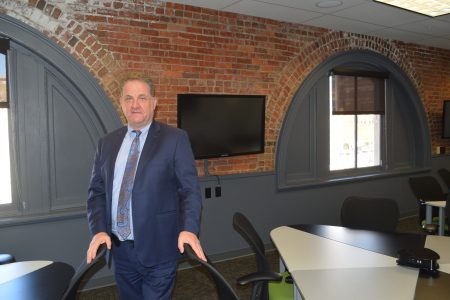
WHEELING - As president of West Virginia Northern Community College, Daniel Mosser believes two words in WVNCC's name hold the utmost importance - "community" and "college."
And in his mind, "community" is a rung higher on the ladder of importance than "college."
"I always say that 'community' is most important," Mosser said. "With the focus on community, that gets you focused on the needs of the employer, the workforce needs, the non-traditional learner.
"But the other word in that name is 'college,'" he continued. "We're always going to be a college. We'll always be here for that 18- to 21-year-old that is the first in their family to go to college. And they need to balance work, family and college. We'll be there for them."
Mosser's mission is to fortify WVNCC's role in the Ohio Valley. He wants it not only to remain that bridge between high school and four-year institutions, but to also be a hub for people who want to join the workforce and gain the training necessary to be successful.
Mosser's background makes him capable of leading Northern in balancing both responsibilities. He holds professional teaching certifications in both Pennsylvania and Maryland and has taught at the middle school, high school and college levels.
He also has served as director of curriculum and instruction for Home Builders Institute and the National Association of Home Builders in Washington, D.C., as well as vice president for education and workforce development with Associated Builders and Contractors Inc. and vice president for workforce development and continuing education for Prince George's Community College in Maryland.
Prior to arriving at WVNCC, Mosser was vice president for continuing education and workforce development at the College of Southern Maryland. So he understands the importance of community colleges in the training of traditional and non-traditional students to enter the workforce.
Beyond two-year degrees, Northern also has programs for people to obtain commercial driver’s licenses, EMT certifications and welding certifications. Students can get a two-year welding technology degree or enter a summer welding program that gets them job-ready. That program filled to capacity last year and is scheduled to hold two sessions this year.
"The average youngster today, they say, will have about a dozen careers," Mosser said. "Not just jobs, but switching (careers). And in order to make those switches, they'll have to come back to the community college or some organization over and over again and be retooled.
"So the emphasis you're seeing on that adult worker, that non-traditional worker," he added, "is an outgrowth of that changing workplace and the needs of the workers to return and be retooled."
When Mosser arrived at Northern in September 2019, one of the things he did was commission a study that looked at the needs of the community in terms of workforce and how the college could help.
"We took a hard look at labor market information, looking at job openings, job opportunities and replacement needs in industries," he said. "We've identified a number of areas to focus on."
Northern has three campuses, in Weirton, Wheeling and New Martinsville, and Mosser said each campus is geared to helping the needs of industries in each of those three communities. The key, he said, is to find partners in each of those communities to help combat problems and find solutions. That was a place where Northern needed to improve when Mosser arrived, and he feels the college has grown in that regard.
"By coming together collectively, we can address some things like low labor force participation rates, low education levels, the opioid crisis," he said. "No organization by itself can attempt to address those issues effectively. By coming together with other not-for-profits, with elected leaders, with school systems, we can start to have an impact."
Looking toward the horizon, Mosser sees Northern growing even further, especially in the field of online learning. The COVID-19 pandemic led the college to move many of its classes online, and Mosser thinks the successes found in that endeavor will boost the concept in the future.
"I think a lot of lessons we learned in the pandemic, when it is post-pandemic, are going to enable us to move in some different directions or move more quickly than we had planned on," he said. "We had dabbled in online for decades, moving quite slowly in higher ed. Online in higher ed is much more widely embraced, and I think we'll continue to offer a mix of programs on campus, online and hybrid. But I think the student emphasis to take courses online is higher than it ever has been and I think that'll only continue post-pandemic."