
Seeing And Believing
Trending
WHEELING -- There are people who live with priceless paintings -- so deep is their love for art, a certain artist or both. There are people who live with valuable baseballs signed by Babe Ruth -- so deep is their love for the sport. And, there are people whose office decor includes what could be a fragment of the actual cross on which Jesus died.
The staff at St. Alphonsus Roman Catholic Church of Center Wheeling are among the latter. And, they say it's a love of God that's behind the collection and display of such tangible bits of a religious life built largely around faith.
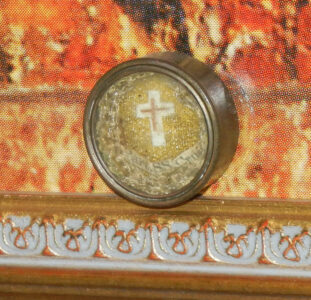
In this case, there's a framed replica of the San Damiano cross -- which is associated with St. Francis and a vision he had of Jesus commanding him to rebuild the church. A tiny circle of gold at the base is small enough and plain enough in comparison to the imagery on the cross to pass notice.
But, in that circle is an even tinier cross -- a mere splinter of wood. In a church so rich in religious relics -- mostly whole bones and bone fragments from various saints and martyrs -- it has been featured in a televised segment on West Virginia Public Broadcasting, the cross fragment manages to stand out.
Is it possible that a piece of what Roman Catholics and some other branches of Christianity refer to as the True Cross is right here in Wheeling? The answer is a definite maybe.
LONG, WINDING ROAD
Here's a quick history of the True Cross, based largely on written accounts.
Ancient historians including Socrates recorded that Helena, the mother of Roman Emperor Constantine, traveled to Jerusalem, the site of Jesus's crucifixion, around AD 326-328.
This is where the story gets fuzzy. Some of the historians claim that -- in addition to founding churches, creating programs to help the poor and setting the wheels in motion for the construction of the Church of the Holy Sepulchre on the site of Jesus's tomb -- Helena discovered the three crosses used to crucify Jesus and two thieves who were executed to his sides. A miraculous healing was said to identify which cross belonged to Jesus.
Another key historian, Eusebius, extensively chronicled the discovery of Jesus's tomb but does not mention any cross. By the late AD 300s, however, multiple texts mention that pieces of what was purported to be the True Cross had been widely distributed to and were being venerated at churches and religious institutions throughout the known world.
To further complicate the story, the Roman Catholic and Eastern Orthodox accounts are challenged by other branches of Christianity. John Calvin, one of the fathers of the Protestant Reformation, for example, scoffed that there are more fragments in the world than a single cross could possibly produce. A calculation of the volumes of known cross fragments in the world done in 1870 suggested the pieces would fit together just fine, however.
Another wrinkle involves the popularity, during medieval times, of both creating replica relics and touching ordinary objects such as textiles to religious relics whose authenticity was unquestioned. Over time, some historians speculate that these relics-by-touch have been confused as being of first-class status.
Either of these practices could explain why one purported fragment of the True Cross that was in possession of Waterford Cathedral turned out to be from the 11th century when it was tested at Oxford University in 2016, according to written accounts.
From wherever and whence various fragments came, they are still widely distributed and venerated to this day. Notably sized fragments remain in such locations as Jerusalem, Armenia, Ethiopia, Greece, Rome, Belgium, Spain and the Philippines. Splinter-sized pieces such as the one displayed at St. Alphonsus are more widely distributed.
In a final bit of cross lore, a fragment that was placed in a chapel on board the Russian missile cruiser Moskva by an Orthodox priest presumably sank to the bottom of the sea.
The ship was destroyed in April 2022 during Russia's ongoing war with Ukraine.
SEEING & BELIEVING
Father Joseph Wiley, parochial vicar for St. Alphonsus, said he just enjoys the relics for what they are. In the case of the many bone fragments that are worked into the church's ornate altars, he sees the relics as a tangible connection to people whose faith was worth admiring and emulating.
That could be a man named Faustus who was martyred in Rome and some of whose bones are now among those stored inside one altar, Wiley noted. That could be a variety of men and women who are now considered saints and whose remains adorn panels in the church's side and high altars.
Wiley said the oaken panels were built into the church when it was constructed in the 1850s. Each one rotates, displaying silk-wrapped relics on one side and religious art on the other. Late in the year -- around All Saints Day -- Wiley turns the panels so that the relics can be seen by the congregation for a handful of weeks. The panels otherwise display their art side.
"They still work," Wiley noted in admiration of the nearly 170-year-old craftsmanship.
St. Alphonsus, he said, has the largest collection of relics among Catholic churches in West Virginia. Most of the 256 items, he said, were brought to Wheeling by the German immigrants who established the church. He believes some were donated in gratitude to God for a safe trans-Atlantic passage.
Valleri Gordon, the church's recently hired secretary, has an office near the True Cross reliquary. She said she also enjoys the tradition of relics and belongs to the why-not camp concerning the cross fragment's authenticity.
"I believe that it probably is part of the True Cross," Gordon said. "The crucifixion of Jesus is recorded in history. There had to be a physical thing."