
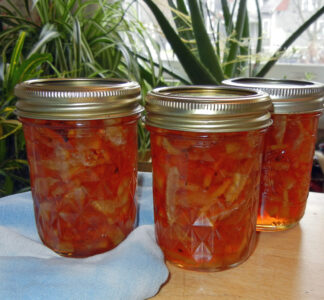
Marmalade: Sunshine in a Jar
Trending
WHEELING -- Orange marmalade doesn't care if the sky is gray. For at least a couple of hours, it will turn your kitchen into a steamy, citrus-scented slice of the tropics.
Canning captures the best of every season that way, noted Cheryl Kaczor of the West Virginia University Extension Office in Marshall County. Kaczor, one of the region's food preservation experts, said her own family is still enjoying hot pepper jelly they made last July.
"We had tons of peppers," she said pragmatically, adding that she also processed a multitude of tomatoes last summer. "You never know what you're going to get."
The bleak mid-winter might not seem like the time to once more fire up the jam kettle and haul out the canning jars, but Kaczor said it is. In both fall and winter, she said she is often besieged with questions from hardcore canners who are taking advantage of comparatively low meat prices, particularly for pork.
Canning meat requires a skill level beyond that of most home cooks as it needs to be done to laboratory standards to be safe. But, there is another seasonal abundance that can be easily tucked away just now - citrus.
The multi-variety crop is at its peak until March, and marmalade is a fun way to store up some of that sunshine for a snowy -- or rainy, as the case may more likely be -- day.
MARMALADE 101
Isn't canning difficult? Yes and no, Kaczor answered.
Low-acid products such as vegetables, soups and, especially, meats require pressure canning and exacting standards and conditions. But, high-acid foods like jams, jellies, marmalades, relishes and pickles need only a hot-water bath in order to be safely preserved.
Today, Kaczor prefers an electric hot-water bath for such canning as it doesn't heat up her kitchen as much in the summer. But, she said that there was a day when she was less cautious about this type of canning.
"Years ago, when my mother and I were making a lot of jams and jellies, we didn't process it," Kaczor said of earlier standards. "We just put wax on the top."
The United States Department of Agriculture (USDA) and the National Center for Home Food Preservation now recommend the hot-water canning method for all high-acid foods, she explained a growing body of knowledge about food safety.
A single exception, however, is high-acid food that is immediately refrigerated and eaten within a couple of weeks. It is safe to ladle products such as marmalade into clean jars, let them cool to room temperature and refrigerate them for up to two weeks.
Regardless of processing, Kaczor recommended that home canners use the USDA-tested recipes found on the National Center for Home Food Preservation website. Those recipes -- including the ingredients and basic techniques of the one printed below -- are specifically tested with food safety in mind.
This can be a moving target, she noted. The USDA has discovered, for example, that some modern tomato varieties are lower in acid than their historic counterparts. Kaczor said this means lemon juice must now be added to some tomato recipes to ensure a high-acid environment for canning.
One additional canning caution Kaczor mentioned concerned stoves. She said some flat-top stoves cannot handle the weight of canning kettles. Gas stoves, which have a sturdier surface, also offer the most control for this type of cooking.
Orange Marmalade
– 4 cups thinly sliced orange peel with pith
– 4 cups orange pulp, cut up and separated from membrane
– 1 cup thinly sliced lemon with entire peel
– 6 cups of water
– 6 cups of granulated sugar
For short-dated, refrigerator-stored marmalade, begin by setting aside 7 to 8 clean half-pint jars. Cut the ends off 4 or 5 large, washed oranges. Balance each orange on one flat end. Using a chef's knife and slicing from top to bottom along the curve of the fruit, slice off the rinds (including the white pith) in strips. Cut each strip into 1/8-inch pieces until you have 4 cups of sliced peel. Set aside.
Working over a bowl to catch juices, cut each peeled orange in half crosswise. Work section by section, inserting your thumb to separate the fruit from the membrane. Squeeze membranes to release any remaining juice. Discard membranes and any seeds. Continue processing the fruit until you have 4 cups of fruit and juice. You may need more peeled oranges to reach this amount.
Cut washed lemon(s) in half lengthwise. Cut into 1/8-inch slices, including peel, until you have 1 cup. Discard seeds.
In a large kettle, bring fruit, peels and 6 cups water to a boil. Cover, reduce heat to medium and cook for one hour.
Add 6 cups granulated sugar, stir until sugar is dissolved and the mixture has returned to a boil. Being careful not to get burned with splatters, reduce to medium heat and cook - uncovered, stirring occasionally and skimming off foam with a spoon as needed. Keep this up for about 45 minutes or until mixture has a jelly-like consistency if spooned onto a cool plate.
Remove from heat. Stir to distribute peels evenly and ladle into prepared jars, leaving ¼ inch space at the top. Wipe the jars' rims with a clean, damp paper towel. Cover with canning lids and rings and let cool to room temperature. Refrigerate and enjoy within two weeks.
If you cannot use (or share) your marmalade within that time, the USDA advises processing the jars in a hot water bath for 5-10 minutes as part of the cooking process. Complete instructions for this type of canning can be found at the National Center for Home Food Preservation website.
A serving note: The bitter-sweet flavor of orange marmalade mixes well with both meat and spicy heat. Consider serving it chutney style with pork or poultry. It can also provide a zingy twist on the classic PB&J. Pair a corn tortilla with a nut butter, the marmalade and some slices of pickled jalapeno pepper. This intense jam also makes an excellent filling in between cake layers.
###