
Marshall County Schools Preparing Re-Entry Plan for September
Trending
MOUNDSVILLE -- A thick packet of regulations and recommendations will be the guidelines for Marshall County Schools to consider when devising rules for returning to school in the fall.
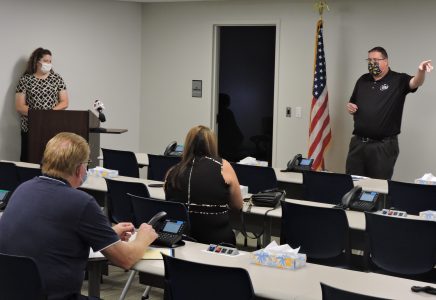
Adhering to the requirements while figuring out which recommendations could best be followed has been the challenge when devising the re-entry plan, said Superintendent Shelby Haines, who spoke to a small gathering of local emergency management officials and governmental representatives.
The meeting was held Wednesday morning at the Marshall County EMA Emergency Operations Center.
Last week, the West Virginia Department of Education distributed draft calendars which were reviewed internally and compared with other county's proposed calendars. This week, Marshall County's principals will review and comment on the calendars, which will be brought to the Board of Education on July 28 for approval.
Haines said the tentative plan is to have students return by Sept. 8, though teachers and staff can begin before that date to prepare for remote learning, which she said is likely inevitable for the school year.
Parents will have the option to have their students learn remotely from home, if they or the students do not wish to return due to health concerns.
Haines recommended those interested in remote learning sign up for that option in nine-week blocks.
"Everybody wants details, but it's difficult to make details in an ever-changing situation," she said. "One of the things we can control is a remote-learning option. If there are parents who choose to have their children attend school via distance learning, we will work on an option to address those needs. Some people don't want to send their children back because they're scared, or they're immunocompromised.
"The other thing is that we will ask people to sign up for that option for nine weeks at a time, because we want to be able to change, If this changes in nine weeks and you want your child to come back to school, then they should."
Teachers had been asked to discuss whether they felt safe to return to school, and those who did not were discussing taking medical leave. All substitute teachers on the roster were also contacted to ensure that they would be available to return for the coming school year.
"We want everybody to feel safe," Haines said.
Marshall County Health Administrator Tom Cook said he had been working with the school district since early March, before schools were even closed, to begin work on the re-entry plan. Haines and members of the Board of Education have repeatedly stressed the importance of working with the health department, which has helped at every step of the way in navigating the pandemic.
"I have literally spoken with (Cook) every day since March 13," Haines said of the day schools across West Virginia were closed by Gov. Jim Justice.
Regulations in the re-entry tool kit include marking social distance guidelines in waiting and reception areas as well as locker and restrooms, limiting nonessential visitors and activities involving external groups, and requiring masks for students and staff when outside of their core classroom groups, if distancing cannot be maintained. Haines added that Plexiglas will be made available for school secretaries.
Haines said she was very thankful for the district's voters for their support on the renewal levy, which allowed the district to employ 12 nurses -- far in excess of the two mandatory nurses on staff countywide.
"We're very lucky in Marshall County. According to state code, we should have two nurses in the district. We have 12, because of our levy, and thank goodness," she said.
Other concerns for re-entry are with student transportation. Bus drivers, Haines said, are the area where the fewest substitutes are available, due to the specialized training required to drive the buses. Haines said the district is happy to train any prospective driving substitutes for free, but the extent of how student busing will be affected is yet unknown, due to uncertainty with how many students will be kept home come the beginning of the school year.
"Bus drivers is an area where we have the least amount of substitutes and the least amount of wiggle room," she said. "Part of our parent survey was ... that we just need an idea. We don't know if it's five kids who want remote learning, or 500. One of the questions was, 'If your student were required to wear a mask, would they ride the bus?' And some people just said, 'No, I'll drive them myself.'
"We have some buses that are really packed, but if we can say ... that 40 kids aren't going to be riding, we can spread them out. Other buses might be okay. Our really packed buses would be the first ones to focus on and spread them out as much as we possibly can."
Haines did say that the thought of using multiple buses per route to allow social distancing had been talked about, but was not feasible for every route.
Haines has said on numerous occasions that the goal has always been getting students back in school. She said that referrals to Child Protective Services have gone down significantly, which she feels may mean that students aren't getting help they may need.
"We're worried about our children. We heard from the state department that our CPS referrals around the state are as low as they've been in five years. That, to me, is not a good sign. We still have a lot of kids in crisis, and we need to put our eyes on those kids. We will do whatever we can to have our kids back in school and follow these re-entry guidelines."
Dr. David Hess, president and CEO of WVU Medicine Reynolds Memorial Hospital in Glen Dale, said he hoped that the district's explanations and transparency would help keep the public informed of the steps taken locally to combat COVID-19.
"They have to understand that this is reality. Explaining the 'why' you want in-person learning ... would be helpful for the community," he said. "When comments come from the American Academy of Pediatrics are recommending it, … I think that's important when you take away all the personal emotions and politics out of it, and say, 'We're following the science, we think it's best for the kids.
"When you talk to the parents, they seem to think we're pushing forward for other reasons or agendas, when really we're putting science and the kids first, it may take away a lot of the phone calls. I get questioned on a lot of the things that we do, and when you put patients and the science first, ... it's much harder to argue."