
Gardeners Ramp Up Planting For Prep for Food Shortage
Trending
ALPENA, Michigan -- More people are planting gardens and gardeners are planting more crops this year, in response to concerns about the coronavirus outbreak causing a food shortage.
Experts have not confirmed there will be a shortage, but gardeners are still beefing up their vegetable planting in preparation.
Ray Burns owns and operates Zdrowy Farms in Posen, Mich. Preparing for a food shortage is smart in the current climate, he said, noting that the coronavirus and business shutdowns to prevent the spread of the virus continue to create uncertainty about the nation's food supply.
"We're ramping it up this year," Burns said. "The world can change. The world has changed a lot in a week, and it's going to continue to change."
According to the United States Department of Agriculture Economic Research Service, farming peaked in 1935, with 6.8 million farms. That number has shrunk to just over 2 million as of 2017, the USDA website reports.
During World War II, the U.S. provided food to much of the world, Burns said.
"We literally won that war because we fed troops all the way around the world from what we could harvest," Burns, 50, said. "I look at that also as a nourishment and food quality thing."
He said growing your own food is more nutritious and more economical.
"Famine is a real issue in the world," he said. "And the policies we use to run this system do not favor food security. They favor corporate profits ... It's a health and security issue."
Being prepared is the best way to secure a brighter future, said Burns, a former Eagle Scout.
"My effort is to get everyone who can produce, producing," Burns said. "It is the only way we're going to come through this with a level head."
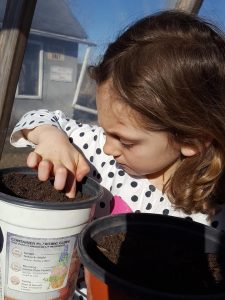
He and his family have enjoyed gardening together for eight years. Especially during these times of isolation at home, he said, gardening provides a great bonding experience for him, his wife, Loretta, and their two children, Matthew, 9, and Helana, 6.
"We've found a great bit of relaxation and joy" from gardening, he said. "Although it is physical effort, and it is work, it's been great ... It's a great way for my kids to understand that food is important."
Burns has been doing nutritional consulting for 20 years, and is working toward his chiropractic degree.
"I see the importance of nutrition in the cycle of keeping someone holistically healthy," he said.
He encourages others to plant a garden, raise some chickens, and "do what you can to sustain yourself, like two generations ago did, and survive the crisis.
"The only way I think we're going to get through this, as a country, is put food in the ground, and have dinner table conversations, and go back to talking to your neighbors even if it has to be six feet away," Burns said. "We are at risk ... What matters right now is getting nutrients into people, because, without it, we'll lose."
Right now, the United States imports about 15 percent of its overall food supply, according to the U.S. Food and Drug Administration. Today, according to its website, more than 200 countries or territories and about 125,000 food facilities plus farms supply approximately 32 percent of the fresh vegetables, 55 percent of the fresh fruit, and 94 percent of the seafood that Americans consume annually.
Burns said we need to provide more of our own food in the U.S.
"Reconnecting with our neighbors in our own local economy is really -- and basing it on local food -- I think it's going to be one of the most precious commodities available," Burns said. "Even if the world straightens out in a month."
Rose Bisanz owns and operates The Rose Garden of Greens in Ossineke, Mich.
"My farm is the CSA-style, which is community-supported agriculture," Bisanz said. "I have members who buy shares of the harvest early on in the season, like in the spring and such, and then, come summer and fall, I deliver the harvest to them, so boxes of veggies every week throughout the season, go to them.
So the community supports the farmer, and, in turn, I support them. It's a more one-on-one relationship than, say, a farmer's market."
She grows about 40 different types of vegetables.
"I grow whatever I can grow in northern Michigan," she said.
She acknowledged a surge in growing and farming interest related to the coronavirus pandemic.
"There's a worry about it," Bisanz said of a possible food shortage during these unprecedented times. "I definitely am seeing a lot of it now. I was actually just telling someone the other day I can't get the chicken varieties that I want right now because people are buying chickens all of a sudden. It's one of the easiest and first steps into being self-sufficient, as far as, with eggs and such, people buy up chickens. That and gardening."
Even if you only plant one thing, that's a step in the right direction, she said.
"Whether you are providing yourself 5 percent of your food from your garden, or you get to the point where you're providing yourself with 50 percent, you're one step closer to being self-sufficient, and I highly recommend that to anybody," Bisanz said. "And that's coming from somebody who is selling vegetables for a living.
"I still love seeing people gardening on their own," she added. "I always tell people, if you want to know where your food is coming from, and you want to always have food available, your first go-to is growing your own."
Billie Thompson and her husband, Bill, own White Barn Gardens on M-72 in Harrisville, Mich. She's doing the same amount of planting this year, but she said many people she has talked to are planning to either plant more or return to planting this year.
"I've heard from some people that are thinking about putting a garden back in," Thompson said in response to the threat of a possible food shortage. "They're thinking, 'I can harvest my own stuff and put it in the freezer or can it.'"
She plants peas and onions early in the season because they are cold crops, and adds more as temperatures warm up into the summer.
Anyone can start a garden, she said, and she encourages them to "start out small, and plant what you like."
"You can put a lot of stuff in an eight-by-eight-foot garden, if you plant it correctly," Thompson said.
Mary Centala owns and operates Heritage Acres greenhouse, nine miles out of Alpena.
"As 2020 was going, I thought, 'I better plant more plants, because who knows what's going to happen,'" Centala said.
The certified Master Gardener planted more tomatoes this year, including her late uncle Claude Robarge's "Campbell's" tomatoes, which have been acclimated through seed saving to make them hearty and able to withstand colder temperatures.
Tomatoes are a favorite for first-time growers, she said.
"Traditionally, when people come to my greenhouse, if they plant nothing else, they plant tomatoes," Centala noted. "Because a tomato fresh from the garden is heavenly. Especially when it's warmed in the sun and you pick it right then and there."
Centala encourages gardeners to plant more this year if they can, as a safeguard against a possible food shortage, as well as a sustainability effort as times change amid a global pandemic.
"Our world has changed tremendously in just the last couple months," Centala said. "My parents grew up during the Depression, and they used to talk about various things they had to do, because they had to do them."
Centala added that growing your own garden is beneficial, no matter what happens.
"Even if the world changes and you don't need that food," she said, "it doesn't hurt to arm ourselves with the knowledge of how to do it."