
Moundsville Leaders Hear Proposal for $4 Million Indoor Recreation Center
 Emma Delk
 Trending
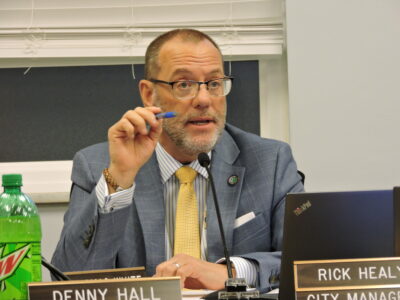
Moundsville City Manager Rick Healy and Parks & Recreation Director John White gave a presentation for a $4 million indoor recreation center located at the former Sanford Center property during a City Council Policy Subcommittee meeting on Tuesday.
The approximately 20,300-square-foot facility would contain two basketball courts, an indoor track, two batting cages and fitness equipment.
The facility would be located at the former Sanford Center property, which the city owns. Healy and White presented the draft of the facility's layout created by the engineering firm The Thrasher Group to council members.
The front portion of the building contains a lobby area with a greeter desk and a concession stand. The front area also contains a social area with televisions and a community room that can be used for parties, meetings and other activities.
Another portion of the front of the facility would contain a dedicated workout area with fitness equipment. The space would include treadmills, ellipticals, bikes, a rowing machine and free weights. The front portion of the facility would also house men's and women's locker rooms.
The back section of the facility would contain two basketball courts that Healy said would be "suitable" for tournament activities, including basketball, pickleball and volleyball, and other sports programs such as summer camps. Another area in the back portion of the facility would contain two retractable batting cages.
The courts, community room and batting cages would be available for rental. Healy and White presented various membership packages as well as a proposed general admission cost of $5 a day and a daily walkers admission for track access of $2 a day.
The metal building would cost approximately $3.25 million to construct. Other aspects of the construction, including HVAC installation, the purchase and installation of Teraflex flooring and various equipment and utilities purchases, drove the estimated construction cost to just over $4 million.
Healy said the city had a partnership in place that he would not divulge the name of during the meeting that committed to supplying $1.5 million towards the construction. In addition to that sum, Healy said the city's recreation fund had $800,000 that could be put toward the project.
"Mayor [David] Wood asked us a couple of times, 'What do you want to do with that rec fund money?'" Healy said to council members. "We're just letting it build because we knew we wanted to come to you and say, 'We have a million dollars in the rec fund to add to that million and a half. We're not there yet [to the $1 million in the recreation fund], but we're close."
Healy noted that if they were to "come up short" on funding for the project and needed to borrow the city could do this, but it would be for a "very small amount" of money. He proposed the borrowed money would be in the million-dollar range "at max."
"We're around $4 million for construction, keep in mind that we have one and a half [million] coming in already," Healy said. "We have almost a million [in the recreation fund], so we're a million and a half away from our number [the total $4 million construction cost]. That's not really that far."
Following the presentation, Mayor David Wood said he thought it was "very good," but his concern was how to sustain the facility. He noted that it would be "very important" for the recreation center to host summer activities, as the facility would have to have "something going on all the time to be successful."
"When I first heard about this [indoor recreation center] two or three years ago when [councilwoman] Ginger DeWitt brought it to our attention, it was just a thought," Wood said. "You guys [Healy and White] have taken another step, which I really respect. I really look forward to going forward with it now."
Policy subcommittee members unanimously recommended that Healy be authorized to enter into a 5-G process to procure an architect for preliminary design work for the project. State code requires that a city undergo the 5-G process to begin a project that is over $250,000 to secure an architect.
Healy noted that the 5-G process would take about 90 days to complete and that this did not mean that the city was committing any money to the project other than the cost of completing preliminary work for the architect search process.