
Trending
WELLSBURG – The statewide drought that began in mid-July has negatively impacted all aspects of local food production, including produce and livestock farmers, feed sellers and grocery stores. Local farmers are now hoping for substantial rain before the first winter freeze to ensure the soil will have enough moisture to produce next year's crops.
Wellsburg-based farmer Eric Freeland stressed "time is of the essence" when it comes to the area receiving enough rain to replace the water table, which is the water available in the ground, before winter.
Freeland said the water table has become "exceptionally low" due to the drought. If there is not enough water in the ground to supply springs, streams and wells, Freeland anticipates significant crop losses next year.
Dale Sampson, owner of Dale Sampson Feed Store, said a "steady rain" is required to replenish the water table before the ground freezes.
"If we don't get the water table replenished by the time the ground starts freezing, the rain and snow won't be able to go in the ground to replenish springs and wells," Sampson said. "By the time freezing weather comes and we haven't had substantial rain, we will be in really big trouble.
"If you don't have water," Sampson added, "you don't have anything."
Even if enough rain comes before winter to restore the water table, Freeland noted the drought has already resulted in significant crop losses for him next year.
According to Freeland, perennial fruit, such as raspberries and strawberries, and orchard crops, such as apples and peaches, should have already begun developing buds this fall. Due to a lack of moisture in the ground, the new sprouts required to grow these crops next year have not developed.
"The drought is going to be catastrophic for next year's crops, especially on the younger fruit trees that didn't have any moisture to develop," Freeland said. "It could be quite a bleak year next year for anyone trying to grow these crops."
The drought has also limited agrotourism opportunities on local farms. Freeland has had to cancel all of his farm's fall activities. His corn maze, which usually grows up to five or six feet, only reached a foot in height this year.
"We've had to pull the plug on any of our agritourism activities," Freeland said. "We've made fall such a big season on our farm with our corn maze, sunflower patch and lush fields. You can't have a corn maze when your corn is only a foot tall and can't even tassel."
Jerry Ebbert, owner of Ebbert Farm Market in St. Clairsville, said he was "blessed" to have a full pumpkin patch this year despite the drought. He noted the farm had to forgo its last two plantings of sweet corn because the crop quality would not reach their standards.
"There's only so much you can do in farming to prepare for a dry year," Ebbert noted. "None of us have seen a year this dry before."
In addition to limited harvests produce-wise, the drought has also impacted farmers who sell animal products. Freeland's neighbor, Jeff Miller, owner of Miller Farms, has struggled to keep his Angus beef cows well-fed and hydrated.
Miller said the pastures his cows need to graze on are "gone." His grass that should typically not grow "any shorter than three inches" has been reduced to dust.
"You don't want pastures to get any shorter than three inches, and you prevent that by rotating cows to different pastures," Miller said. "When the pasture regrowth is this slow, the grass is down to nubs. It looks like Texas when my cows walk across the pasture because there's a cloud of dust behind each one of them."
The current state of Miller's grass will negatively impact his cattle next year. He estimates he will have to keep cows off the pasture until June when they can typically begin grazing again in April.
Miller has already begun using grain and hay to supplement his cattle's lost grazing diet. He noted he would typically not use such large amounts of feed until Thanksgiving.
Miller fears he may have to sell his cows earlier as he may not have enough food for all of them.
"We must have a reason to sell the mother cows as they are important during breeding season," Miller noted. "If any cows aren't bred, usually we can keep them around and figure out why they didn't get pregnant.
"If those cows aren't bred this fall, I'm afraid they have to go," he added. "I won't have the feed to keep a cow around for another six months to rebreed them."
The price of the hay used to supplement the diet of livestock due to the dried pastures has "doubled or tripled," according to Sampson.
"Farmers have to feed their animals as much hay as they would feed them in the winter time because pastures are so dry," Sampson said. "Farmers have begun using grain as a substitute to make the hay last longer and go farther."
While Sampson sells the grain local farmers need during the drought, he noted that farmers do not have the extra money to purchase feed from him.
"Feed store owners hate this kind of a year because these farmers need to buy our feed, but they don't have the extra money to do it," Sampson said. "People think because somebody has to buy something, they have the money to pay for it. When you're just trying to survive each day on a farm, you aren't counting on spending any extra money for feed.
This drought has put a hardship on farming families, feed dealers and hay dealers," Sampson continued. "It puts a hardship on everybody."
The production of other types of livestock has also been negatively affected by the drought. Allen Hager, owner of Fluffy Butt Farm in Cameron, estimated he has performed 75% more labor this year to make sure his free-range chickens are well-fed and comfortable enough to produce eggs.
Hager transports his poultry in a chicken tractor to different areas of his pasture so the animals have enough grass to eat. He added he had not cut his grass in a month and a half, as every blade is needed for his chickens to eat.
"The chickens get moved a lot more often now because they just eat up the grass as fast as I put them on it," Hager said.
Hager stressed the importance of keeping the poultry comfortable. If the chickens are too hot, which has also been a problem due to high temperatures this fall, they will become stressed and not produce as many eggs.
"Fortunately, on the egg side with us, there hasn't been an impact because the chickens are free range and can run into the woods and get some shade where it's cooler," Hager said. "I know many of my neighbors and a few farmers that sell at the Public Market that had their chickens quit laying altogether."
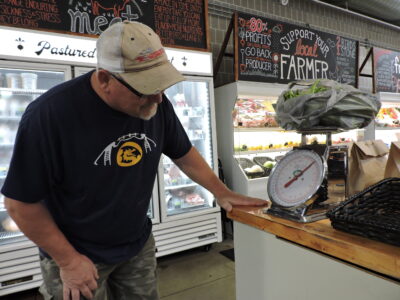
Like his neighbors and other local growers, Hager sells his produce and other food items at the Public Market in downtown Wheeling. On Friday, he brought green beans and chicken bone broth to the grocery store.
While weighing Hager's green beans, Public Market Vendor Manager Sarah Morgan said she has witnessed firsthand the frustration of local growers brought by the drought during visits to their farms to pick up food for the store.
Morgan said she tries to remind the Public Market vendors she visits of this year's positives. She added it was "amazing" that farmers could grow any food during the drought.
"I think the farmers can become discouraged because they can compare what they've produced this year to last year," Morgan noted. "The consumers don't notice that because these farmers still produce delicious food despite the drought. We had some of the best strawberries I've ever seen at the Public Market this year."