
Wheeling Mayoral Candidates Offer Differing Opinions on Homeless Issues
Trending
WHEELING - Those running to be the next mayor of Wheeling have differing ideas about how the city has handled - and how it should handle - its ongoing dilemma related to the city’s homeless population.
During Thursday night’s mayoral debate at West Virginia Northern Community College sponsored by The Intelligencer and Wheeling News-Register, along with media partner WTRF-TV7, the six candidates who are in the race to become Wheeling’s next mayor were asked a series of questions related to homelessness - a topic that many view as an important and oftentimes polarizing one for the city.
Last year, members of the current Wheeling City Council cast a split vote to authorize legislation that bans camping on public property. The new ban went into effect at the beginning of the year, and as a compromise, the original language in the legislation was amended to allow for an exemption for a managed camp to allow homeless individuals to stay there. However, an exempted site was not yet selected at the time the ban was enacted - which stirred the ire of homeless advocates.
Two current council members who are running for mayor voted differently on the legislation. Vice Mayor Chad Thalman voted for the ban, with the exemption. Councilwoman Rosemary Ketchum voted against it, as did current Mayor Glenn Elliott, who is finishing out his second term and cannot run for reelection to the mayor’s post because of term limits. On Thursday night, Thalman and Ketchum along with fellow mayoral candidates Dennis Magruder, Beth Hinebaugh, J.T. Thomas and Carl Carpenter were all asked whether or not they support the city’s public camping ban.
While they were asked to answer "yes" or "no," most could not help but to elaborate on their response.
"I intend to say a little more than just ‘no,’" Carpenter said. "I think the city treated the poorest among us in the most callous and cruel manner possible. No, I do not support what they’ve done to the homeless community in Wheeling."
Magruder said when talking about the homeless camp, public safety and health issues have to be taken into consideration - not only for those who are unhoused, but also for the rest of the community.
"I definitely support the city’s move on banning random camps," Magruder said. "I did support the idea of a managed camp - I think that’s a transitional piece. There are different kinds of homeless out there. Listen, I am very compassionate, but we have to enforce the law and make sure that all people - the unhoused as well as the other citizens - are safe and abide by the health regulations."
Ketchum noted that she did not support the encampment ban and indicated that she still does not support the measure.
"I thought it was a poor policy," Ketchum said.
"I voted for the encampment ban, with the exception that the city manager has the authority to give the exemption for a managed camp," Thalman said. "I believe that was a 5-2 vote, and I was part of the five in the majority who supported the ban."
Both Hinebaugh and Thomas also said they were in favor of the camping ban.
"I am in support of the ban, but I believe we need to come up with a compassionate way to handle things," Hinebaugh said.
"I too support the encampment ban, for a multitude of reasons," Thomas said.
On Monday, the U.S. Supreme Court is expected to hear arguments related to bans that impact where homeless individuals may sleep - a case originating in Oregon that may likely have far-reaching implications on how local and state governments across the country can address homeless encampments.
Mayoral candidates on Thursday night were also asked whether or not they would continue the position of the city’s homeless liaison. The current city council created the position more than three years ago to help address the homeless situation. It, too, was passed with a split vote, and the position was designed to "sunset" after four years to give the next city council a chance to review the position and decide whether or not it should continue.
Although people in the city and the community have applauded the efforts of Wheeling Homeless Liaison Melissa Adams, the vast majority of mayoral candidates indicated that they would not support renewing the position during the next four-year council term, which begins July 1.
"I do not necessarily support that position," Magruder said.
"I would say that as a result of the work that has been done, I would have to review it, but I might say ‘no,’" Ketchum said.
"The position has not sunsetted yet. The next city council will decide that, so there’s still time to decide. But right now, I’d be leaning towards ‘no,’" Thalman said.
"I’d also be leaning towards ‘no,’" Hinebaugh said.
"Having not had a chance to evaluate that position and know all of the requirements - from the outside looking in, I’d have to say ‘no’ as well," said Thomas.
Only Carpenter indicated that he would keep the homeless liaison position.
"I do not support eliminating the position," he said. "I think the city should look for compassionate ways to help everybody, especially the people who need it the most."

Wheeling mayoral candidates, from left, Dennis Magruder, Councilwoman Rosemary Ketchum, Vice Mayor Chad Thalman, Beth Hinebaugh, JT Thomas and Carl Carpenter offer their ideas on issues facing the city during a debate Thursday at West Virginia Northern Community College, organized by The Intelligencer and Wheeling News-Register and WTRF-TV. (Photo by Joe Lovell)
Each candidate had a different idea about how Wheeling should address this issue.
Ketchum said that homelessness has been one of the biggest issues she’s faced over the past four years in office.
"I represent Ward 3, which is perhaps the most impacted community by homelessness," Ketchum said. "It’s the only ward that has been considered to host the encampments. I think that we have handled the homeless situation - on the city level - very poorly. I led the charge to hire and create the position of homeless liaison. One of the reasons I might not support its renewal is because I think it is solving the problem."
One of the biggest barriers the city has faced in addressing homelessness has been the fact that Wheeling does not have a low-barrier shelter, Ketchum said.
"If you’re not a woman, you’re not eligible for the YWCA," she said. "If you’re not a veteran, you might not be eligible for some of the veterans’ services. If you’re a person who is in active addiction or a mental health crisis, there are very few places to go. So, I think that we’ve handled it poorly. I’m so grateful that we’ve been able to pass the homeless liaison position and hopeful that we’ll be able to continue building relationships with the incredible service providers that are in our community."
Thalman said he stands by the way he and the majority of city council voted on these matters.
"I happen to disagree with the idea that anybody should be able to camp anywhere at any time, for any reason, without permission and without any rules," Thalman said. "I don’t think that’s good for the homeless, and I don’t think that’s good for the city. I don’t believe that enabling people is helping people. I want to be compassionate, and that’s why we gave the city manager the authority to allow for an exemption - to allow for a managed camp."
All members of city council were "absolutely appalled" to see camps bulldozed, Thalman said.
"That is not what any of us wanted," he said. "That’s the decision that city staff moved forward with - that’s how they implemented the policy. But all in all, I feel very confident that city council made the right decision to pass that ban, to stand with our law-abiding, taxpaying citizens and to allow for a managed camp so we can be compassionate and try to help these homeless individuals move on to a better life."
Hinebaugh said that homelessness is a complex issue, and the city needs to have a multifaceted approach to addressing it.
"We need to work more closely with the community organizations who work closely with the homeless," Hinebaugh said. "We need to work with mental health services and with substance abuse programs."
Through her previous work in law enforcement, Hinebaugh said she would see a lot of people leave drug treatment or mental health facilities whenever their insurance ran out, and then they had nowhere else to go.
"They’re kicked to the curb, they’re given a week’s worth of medicine and told to figure it out. That’s not OK," Hinebaugh said. "We need to work with legislators to try to tighten up requirements for those treatment facilities to how they are released back into the population so that they’re not just released into a homeless situation. The city cannot sacrifice its identity. So we need to handle this compassionately and try to work with those who can help us with them."
Thomas indicated that the agencies that work with the homeless need support, as do the people who are actually seeking support.
"I feel like we throw a lot of money at it, and we’ve certainly moved it around from time to time, but I don’t think that we’ve even come close to solving the issue," Thomas said. "Can we ever solve it and eradicate it? I don’t think so. But I certainly think that we need to put the safety of our citizens first, above all, and that’s not something I’m willing to compromise on."
The local organizations that help the homeless are full of true "angels" who are ready and willing to help those in need, Thomas said.
"I think we need to concentrate efforts on those who want to be helped and who want to reverse their situation, because I certainly think that those who want to help are angels and can help these people - if they want to be helped," he added.
"I certainly don’t think there’s adequately help available, after what was done in Wheeling - which again was extremely cruel and callous, to take all the possessions people had, put them in a dump truck and haul them to the dump," Carpenter said. "This is a serious national problem that is greater in many cities than it is here, and the biggest driving force behind it is not drug addiction or things like that, it’s simply an unaffordable cost of housing. That’s a major problem that I’m not promising I can solve, but whenever the city of Wheeling treats people the way that they did - to the encamped homeless - they didn’t do that as the city of Wheeling, they did that in the name of everyone of us. I resent that, and I think it was wrong."
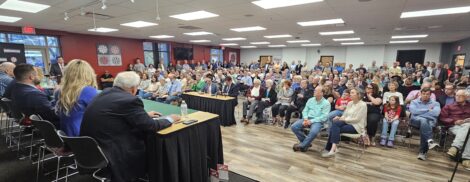
A capacity crowd packed the auditorium at the B&O Building at West Virginia Northern Community College Thursday night during a mayoral debate organized by The Intelligencer and Wheeling News-Register and WTRF-TV. (Photo by Joe Lovell)
Magruder said the homeless situation is very complicated, but the city needs to make the health and safety of everyone its first priority.
"If you have your kids and you go down to the waterfront to the playground, and it’s loaded with hypodermic needles and human feces, that’s not a good thing for the unhoused or the others," Magruder said. "I’m a very compassionate person. But we’ve got to take a look at how we do this."
There are three types of homeless individuals, and each requires a different action, according to Magruder.
"First there’s the criminal - the bully. They’ve infiltrated and they’ve masked themselves as homeless so they can take advantage. I’ve talked to people who used to walk behind the arena, and they’re afraid to walk there. Citizens should not be afraid to walk on our streets at any time, and if homeless people are causing that, then the criminal element we must deal with severely and quickly," Magruder said. "The second element is the addiction and mentally ill. We’ve got to work with social service agencies to try to help them, and work with the state legislature. Yes, they need more money. We used to have asylums and treatment centers, but we’ve closed them up and integrated them into society and created this problem. Thirdly, there are those people who are really down and out, the real homeless - the people who need help. They shouldn’t be relegated to a tent. Let’s get them into a shelter and get them back into society."
Wheeling voters will decide who will become the next mayor during the upcoming municipal election on May 14.