
War in Holy Land Hits Close to Home
Trending
WHEELING - When the air raid sirens sound in the city of Jerusalem, citizens have about a minute and a half or so to take shelter, Cantor Evan Cohen told members of the Temple Shalom congregation Monday night in Wheeling.
A clergy member at the Har-El Synagogue in Jerusalem and a resident of the city, Cohen visited his longtime friend, Rabbi Joshua Lief of Temple Shalom, this week during a trip back to the U.S. His visit comes not only during Hanukkah but also during the ongoing Hamas-Israeli war that has left that region - and people around the world - shaken and yearning for peace.
The unrest was particularly jarring for average citizens living in Israel who suddenly found themselves in the middle of an active war as it unfolded, despite being all too familiar with the Israeli-Palestinian conflict that has lingered for decades.
"It was a scary morning," Cohen said of Oct. 7 when Hamas militants invaded part of Israel, slaughtering innocent civilians - including hundreds who were attending a music festival - and taking hundreds more hostage. But on that day, news about the attacks had not yet come into focus - just alerts of missiles flying everywhere. "Throughout the day, people started hearing about what was happening."
People were shocked to hear initial reports that 200 people had died in the attacks. Then additional reports trickled to the public, and the numbers kept rising and rising.
"Just trying to understand the scale of what was happening - people were speechless," Cohen said. "We realized that this was the worst attack on Jewish people since the Holocaust - all in the span of one day."
While news about the situation was unclear as it developed, Cohen noted that modern technology has blessed Israelis with a cell phone app that can pinpoint a user’s location and provide relevant air raid warnings for zones that are under threat of missile attacks. On the first chaotic day, Cohen noted the fine line between remaining safe inside a bomb shelter versus getting close enough to the door to get enough cell phone signal to remain connected to the latest information.
The Iron Dome - Israel’s air defense system - is quite effective at intercepting short-range missiles, Cohen noted. But being witness to its use can be unnerving.
"You can hear the interceptions - they’re quite loud, which makes it scarier," Cohen said. "When a rocket hits a building, it will thud. When it explodes in the air, there’s nothing to block the sound waves. So it’s really loud."
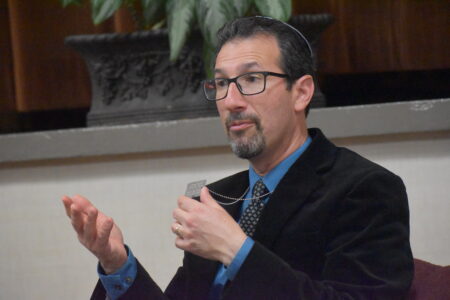
Cantor Evan Cohen displays Israeli dog tags he wears in honor of hostages taken by Hamas militants and held in Gaza. (Photo by Eric Ayres)
Since the initial missile attacks, Jerusalem has become more of a safe space during the war in Israel, Cohen said. Now the area is teeming with refugees, and it is pretty much impossible to get a hotel room. It also has been very difficult to get a flight in and out of the area. The airlines would love to continue commercial flights there, but most of the insurance companies refuse to cover them in air space over active war zones, Cohen indicated.
The Har-El Synagogue in Jerusalem is the oldest Reform congregation in Jerusalem. Cohen’s visit is part of his current trip to the United States that will include attendance at the Reform movement conference in Washington, D.C., celebrating the Union for Reform Judaism’s 150th anniversary this weekend. Cohen also visited another congregation in Miami before stopping in Wheeling.
Monday night’s first-hand accounts of the events in Israel are part of Temple Shalom’s programming for adults this week. Cohen will present a program to youth there today focusing on Hanukkah traditions in the U.S. and in Israel.
Cohen and Lief have been friends for more than 25 years. They met while attending different colleges but while visiting the same convention. They subsequently became classmates in the seminary in Israel and have been close friends ever since.
"I stayed in Israel, and I moved to Israel permanently," Cohen said, noting that he found his calling as a cantor - a member of the clergy in Judaism who leads primarily through music. Lief returned to the states, but they have remained in contact regularly.
"I think it’s a wonderful opportunity for us here in Wheeling to connect directly with our co-religionists across the sea in the Holy Land and to be able to bring Evan to our community tonight," Lief said. "His first-hand perspective reminds us of how interconnected we truly are. I think that’s critical. When we read headlines in the news, it seems distant to us. The reality is that the war going on in Israel right now touches many members of our congregation - myself included."
Lief said he last visited Israel in February. Since the October attacks, he said he knows people who he visited earlier this year who have been killed. He said he knows children who were taken hostage.
"It’s very personal," Lief said. "To realize that antisemitic hatred - that is quite popular on college campuses and on social media right now - hurts us as real individuals. It’s directly affecting us."
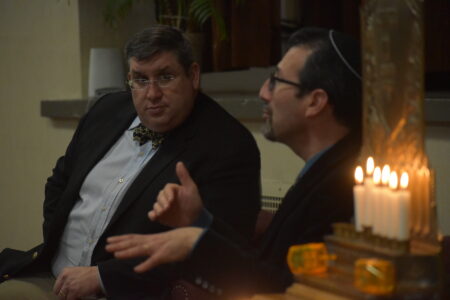
Rabbi Joshua Lief of Temple Shalom listens as Cantor Evan Cohen of Har-El Synagogue in Jerusalem speaks Monday night about the life of average citizens living in the middle of the Hamas-Israeli war. (Photo by Eric Ayres)
Cohen said the political climate is turbulent in Israel since the war erupted. The bottom line to voters, he indicated, was "what political powers are going to keep the citizens safe?" Cohen noted that many Israelis don’t believe it’s the party of Prime Minister Benjamin Netanyahu.
"It’s now gotten to a point where the overwhelming majority of the Israeli public blames him," Cohen said, noting that before the recent attacks, citizen relationships between Israeli and Palestinian neighbors - even those living in the Gaza Strip - were taking steps forward. But that all has now taken a huge step backwards.
"When you’re building trust in any sort of human relationship - trust can be lost in an instant, but it takes years to build it up before you have faith in someone else," Cohen said. "What Hamas was truly successful in doing was setting the peace process back decades - in addition to all the loss of human life."
What gives Cohen hope in the face of the government’s failures, he said, was the fact that "civil society" so quickly sprang into action. And it is on this front - in Israel and around the world - that this war will hopefully come to an end sooner than later, he said.
Connecting with friends and family in Israel brings home the message that these are not separate communities, Lief added.
"In fact, we’re one human family - all of us - interconnected around the globe," he said. "To remember that this holiday season is particularly powerful."