
Wheeling Council Passes Amended Ban on Camping on Public Property
 Eric Ayres
 Trending
WHEELING -- An amended ordinance to ban camping on public property in the city of Wheeling was passed by a majority vote from members of city council on Tuesday night.
The controversial issue has been a brewing topic over the past few weeks since the camping ban legislation was introduced in October, prompting several members of the homeless outreach community to express opposition to any type of action that would displace a number of people who have nowhere else to go. A second and final reading of the camping ban legislation was passed by city council Tuesday night by a vote of 5-2, with Mayor Glenn Elliott and Councilwoman Rosemary Ketchum dissenting.
Amendments to the ordinance prohibiting camping on public property will allow an exception for approved camping locations that may be designated by the city manager. One or more specific locations within the city limits will be exempt from the prohibitions and penalties outlined in the ordinance, which will take effect on Jan. 1.
The amendments to the ordinance also tweaked the penalty section for violations. The amount of fines would be not less than $10 and no more than $500, and community service may be imposed in lieu of monetary fines.
Wheeling City Manager Robert Herron after the meeting said there are "templates" that will be examined from other communities across the nation that host successful managed homeless encampments.
There are no plans at this time for the city of Wheeling to manage or provide funding for such a camp. The amended ordinance simply gives the city administration the power to grant exemptions to the ban by allowing a camp at a designated location - whether that be on public or private property.
"We have had some conversations on this," Herron said. "Our intent would be to work with the agencies that provide services to the homeless to figure out an appropriate location for a managed camp, and I feel as though we'll be successful in doing that."
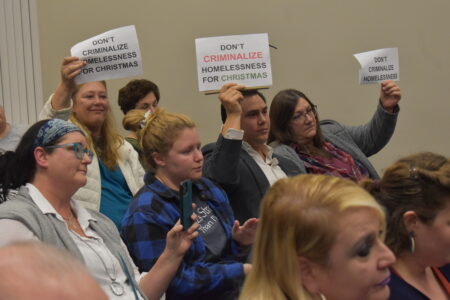
While the amendment seemed to be put forward as somewhat of a compromise, individuals at the meeting who held up signs stating "Don't Criminalize Homelessness for Christmas" applauded council members who chose not to vote for the legislation.
"I made it clear to folks that I've spoken to that I do support a managed camp system, and while I do believe these amendments and this current ordinance is incrementally better than the previous one that we saw, it's still not a solution," Ketchum said. "The issues that we're facing are broad and complex ... and cannot be banned.
"We all remember the 'Just Say No' response from the federal government to drug addiction. This is a 'Just Say No' response to homelessness that unfortunately will not solve the issue that we have."
Councilman Jerry Sklavounakis proposed the amendment to the ordinance and credited fellow Councilman Ben Seidler for spending a lot of time with homeless advocates and working toward a compromise to the issue.
"Over the last three weeks, we put an incredible amount of time and energy into this," Seidler said. "I see all your signs out there that say 'Don't Criminalize Homelessness for Christmas.' I appreciate that, and I've also explained how frustrating it is to see that -- especially since this ordinance takes effect Jan. 1. So you can grab your little Sharpies and change that to 'New Year's.'
"With that being said -- we're not trying to criminalize homelessness," Seidler stressed.
"You are!" several members of the audience interrupted.
Some council members seemed exhausted at the continued criticism.
"The amount of time and effort that every member of council up here has put in on this topic to make this a better solution and find a healthy balance between respecting our homeless community and also respecting our need for public safety is unprecedented since I've been on council," Seidler said.
Sklavounakis, who is an attorney by trade, also indicated that there is case law that goes against the argument that camping bans are "unconstitutional," especially in light of the fact that managed camps are to be permitted.
Councilman Ty Thorngate noted that city council over the past eight years has committed millions of dollars to support local nonprofit organizations and their efforts to address this issue.
"We established a homeless liaison position to help bridge the gap between these nonprofits to provide city council and city government with vital data and help us comprehend the true extent of our own homeless population," Thorngate said. "No matter what obstacles we've faced, we've approached them with unwavering compassion. But, unfortunately, our empathy and willingness to explore all avenues to assist our homeless population have been taken advantage of by a select few individuals."
Thorngate said the overwhelming consensus from his constituents has been clear.
"Our approach to homelessness now has not been effective, and it's time for a new direction," he said. "People no longer feel safe using our waterfront, our playgrounds, trails and creek systems. Countless times, we've all sat here and talked about how one of the most important things in Wheeling is our quality of life, and our residents feel that it's been held hostage."
Thorngate said he personally thinks it's time to end camping and loitering on public properties. Managed camps must come with rules, restroom facilities and hygiene services.
"No more free-for-all," he said. "In my view, such a camp should be operated by nonprofits and faith-based organizations and not the city of Wheeling. The city can offer financial support and guidance, and assure public safety for all."
The mayor commended everyone for working to amend the ordinance to present "something much more reasonable" to council.
"I think this is about 85-90% of where it needs to be," Elliott said. "I could vote for this if we could get a few more steps in the direction of what a managed camp looks like.
"If this could be tabled, I think I could get to where I could support this by the next meeting. I think it's clear that my vote is not needed to pass it tonight, but as it is now, I'm going to have a hard time voting for it. I do think this is an honorable effort to move the conversation forward. It's just not all the way where it needs to be for me to feel comfortable with it."
During the previous council meeting, a total of 19 people signed up to be heard -- most of whom spoke out against the legislation, describing it as a means to "criminalize" homelessness. During Tuesday's meeting, a room full of people attended, and a total of six people signed up to speak against the ordinance, including some of the same community members who spoke out during the previous session. The comments were limited to three minutes per speaker and were heard before council members voted on the ordinance.
"I was homeless until recently," said David T. Miller, who said he was able to get into housing thanks to services in the city that work to support the unhoused. "You cannot and should not put us all in the same category. We are not all criminals, so do not treat us like we are."
Timothy Harriman said he has slept on the street in the past, and added that many homeless individuals suffer from mental illnesses.
"These are people," Harriman said. "They're not just a statistic."
Vincent DeGeorge asserted that federal funding needed to address homelessness could be lost if legislation "criminalizing homelessness" were to pass.
"These proposals without that level of thought and due diligence will lend itself to creating those same types of problems in our city," said Kate Marshall of House of Hagar. "There is a way we can all come to the table and make something that works. I don't think you'll find anyone here who doesn't want that.
"I commend your effort to sit down and think about that, and I ask that we all be a part of it."
Prior to the regular council meeting, members of the Finance Committee of Council had a lengthy discussion about committing $100,000 toward The Life Hub. A majority of committee members elected to move the item on to city council for future consideration. Vice Mayor Chad Thalman moved to table the request until a breakdown of the expenditures was presented, but that motion failed.
"To be quite honest, I still don't grasp how the Life Hub is going to reduce homelessness, so if that can be presented before the next meeting, that would be beneficial for me," Thalman said.
"I think we should know where this is going, because we're going to have to prioritize," Sklavounakis said. "Unfortunately, we don't have a money tree. Our ARPA funds are almost gone. I think that in order for us to make an informed vote, we need to know where the money is going."