
City Looks To Eliminate Downtown Parking Meters
 Eric Ayres
 Trending
WHEELING -- All members of Wheeling City Council shared ideas about the future of downtown parking during a meeting Wednesday, when a consensus was met to eliminate parking meters in the areas affected by the Downtown Streetscape Project.
Officials are leaning toward implementing a new two-hour free parking policy that uses modern technology to enforce it by automatically ticketing violators.
A meeting was held by the Development Committee of Council on Wednesday, but every member of city council attended and weighed in on the discussion.
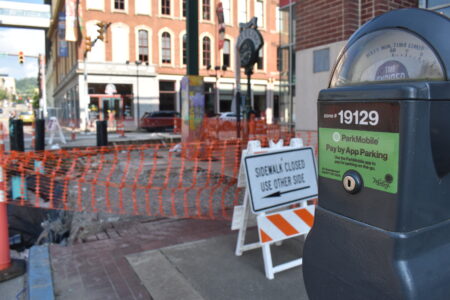
City leaders noted that old parking meters are being removed as part of the state's $32 million Streetscape project that - over the course of the next two years - will bring a transformative facelift to the city's main traffic arteries of Main and Market streets, as well as the sections of connecting streets between them in the downtown area.
"This is a state-run project, but the state has given us some latitude to set the overall parking policy," said Wheeling Mayor Glenn Elliott, chairman of the Development Committee, noting that most of the downtown parking meters are about 30 to 40 years old. "We're definitely not leaning towards putting them back."
Alternative options for future downtown parking policies considered by city leaders included a strictly sign-based system that motorists use an app on their phone, a kiosk-based system as seen in bigger cities where motorists can pay to park at a centrally located booth or a two-hour free parking policy that is enforced - an approach that some communities across the country and even in the Ohio Valley have embraced.
"I was just recently on vacation in July in Fredericksburg, Virginia, and I saw an auto-chalk system," said Councilman Ty Thorngate, a member of the committee. "I think this would help alleviate some issues where we would have police or parking enforcement people going around chalking tires."
Under the auto-chalk system, camera systems are attached to vehicles that patrol the target area and use modern technology to capture images of license plates, calculate the time each vehicle has been at a certain location or in a specific zone and automatically issue tickets for those that violate the two-hour limit or whatever parking time limit is posted in the patrolled area.
"I'd be interested to see what the cost of that would be versus a kiosk system, but I'm really not in favor of putting parking meters back in," Thorngate said.
The current downtown policy allows motorists to feed meters the old fashioned way - by inserting coins - or to pay using the ParkMobile app. There is a two-hour maximum limit to street parking downtown, but enforcement via parking tickets is typically only made for those at expired meters or those who have parked for longer than they have paid on the app.
"I recognize there could be a slight revenue reduction from the meters not being paid," Elliott said, "but for me the purpose for downtown space is not to make money for the city and it's definitely not what I see it being used for a lot - for employees who work downtown to utilize all day, coming out and feeding those meters. I see it happen over and over again from my window, so I know it still happens.
"The purpose of downtown parking space is to facilitate commerce," he added. "Quite frankly, if you are someone who is using those spaces all day, that's very selfish, and it's very inconsiderate to downtown businesses who depend on those spaces for their customers and clients to come and go and have availability of parking."
Elliott said the idea of the two-hour free parking scenario is to encourage people to come down and use those spaces for commerce, but to very strongly discourage people from using those spaces all day.
Officials noted that the proposal is for the areas affected by the Streetscape work, where sidewalks are being replaced, and all of the current meters are being removed. City leaders agreed that meters should not be put back in place after the new sidewalks are installed. They also agreed that a strictly app-based system would not be user-friendly for some older motorists who may not use or be proficient with smartphones, and a kiosk-based system would require utilities and maintenance, and may be subject to vandalism.
The mayor noted that the two-hour free parking concept relies on zones, so a motorist could not simply try to defeat the system by moving their vehicle to another parking space in the same block. Chalking tires by hand seemed like a very antiquated method, officials noted, leaning toward the prospect of the camera-based system that could maximize enforcement and supplement any lost revenues from meter or ParkMobile payments with fees from automated tickets to those who violate the two-hour parking time limit.
While the two-hour free parking incentive does draw motorists to use these spaces, those will also become free within two hours or less because the time limit will be enforced, officials noted.
Long-term parking for downtown employees should be in surface lots or parking garages, not along the streets where parking should be available for short-term visitors to downtown businesses.
City leaders noted that the artificial intelligence that drives the auto-chalk systems is the same type of technology that is common with many systems today, including automated toll-road turnpike systems that take photos of license plates and automatically send motorists a bill for the toll by mail.
The auto-chalk scanners that can be installed on current parking attendant vehicles use the same type of camera technology.
"They are the same type of scanners that police have on their vehicles now where they look for plates with BOLOs (be-on-the-lookout) on them or the same thing that guys doing repos as well," Councilman Ben Seidler said. "That AI technology has really advanced at this point.
"I think we should do everything we possibly can to encourage people to come downtown."
Wheeling City Manager Robert Herron said the city typically collects a couple hundred thousand dollars a year in revenue from the 1,100 parking meters throughout the entire city. There are between 250 and 300 meters within the affected area of the Downtown Streetscape Project. A violation of overtime parking currently warrants a $10 fine.
The Development Committee agreed to direct city staff to investigate options on a two-hour free parking policy that can be digitally enforced for a new system to be implemented after the Streetscape project opens completed sections of the downtown for street parking.