
Trending
Albert Wright, president and CEO of WVU Health System, knows he's aiming very high with his organization's next goal -- to attain a National Cancer Institute designation for the WVU Cancer Institute. Such a designation would be a first in the state of West Virginia and put the WVU Cancer Institute among the top 2% of all cancer institutes in the United States.
Wright also knows he has the full-throated support of Gov. Jim Justice and the West Virginia Legislature. Evidence of that recently came in the form of a $50 million appropriation to earn that NCI designation.
Though the path to that NCI designation is in its early stages, Wright said Friday that he's confident WVU Medicine can reach the finish line. Doing so would be a major boost to fighting cancer in a state ravaged by it, and the effects would be felt strongly in the Northern Panhandle.
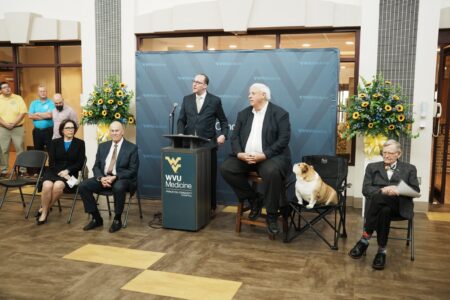
The announcement of this appropriation came Thursday at WVU Medicine Princeton Community Hospital. There, WVU Medicine officials said bolstering the fight against cancer in West Virginia is of the utmost importance.
"There is a cancer epidemic in West Virginia," said Dr. Clay Marsh, WVU Health Sciences chancellor and executive dean on Thursday. "As West Virginia's land grant institution, it's our duty and honor to make sure our state's citizens have access to the most advanced clinical trials, treatments, and care for cancer."
According to the Centers for Disease Control and Prevention, West Virginia has the highest cancer death rate in the United States. According to WVU Medicine, cancer affects one in 10 adult West Virginians and cancer-related medical costs in the Mountain State are more than 2.4 times the national average.
"It's pretty clear we made a pretty compelling case that, if we don't do something very different, we're going to continue to have the worst cancer outcomes in the country," Wright said Friday.
Earning an NCI designation would go a long way in reversing that Wright said. That designation would allow the WVU Cancer Institute to expand beyond the traditional model of diagnosis and treatment. The institute would evolve into a more integrated and comprehensive approach with a stronger emphasis on cancer prevention, especially in underserved populations.
Wright said some of those preventative measures could be smoking cessation, promoting better eating habits and correcting some of the food deserts that can be found around West Virginia, especially the southern part of the state.
To reach that NCI designation, the WVU Cancer Insititute must significantly boost its investment in fundable sustainable cancer research each year. Currently, Wright said, the institute does about $3 million in such research. That number eventually will reach $10 million.
In time, the organization's plan is to have the same type of clinical cancer trials found in Morgantown to be available in places like Princeton, Parkersburg, Wheeling and Martinsburg. That's why the WVU Cancer Institute wants to get that NCI designation not just for the Morgantown site, but for every site around the state.
For a state in which the population is as far-flung as West Virginia, such a goal is necessary.
"We're essentially a decentralized healthcare system," Wright said. "And you can't just say everybody come to Morgantown. So we are actually going to try to accredit the entire institute so that we can say the care you get in Wheeling is the same you get in Morgantown."
Another benefit of the designation will be the ability to put screening capabilities all over the state, whether it be for colonoscopies, mammograms or CT screenings for lung cancer, which Wright said is a major need in West Virginia.
Some of that already is happening in Wheeling. Dr. Robert Herron at WVU Medicine Wheeling Hospital already has initiated a lung cancer screening program to find the disease in its early stages.
Cancer treatment and research will be magnified even more in Wheeling with the planned regional cancer center that will be built on the campus of the former Ohio Valley Medical Center, a site that WVU Medicine said could open in five years.
An NCI designation and the work needed to earn it should greatly benefit that new center, Wright said.
"I suspect we'll actually put some population health researchers up there," he said, "some cancer researchers that are actively enrolling folks in trials and actually have researchers based out of there, so that it is a full clinical trials unit.
"And we'll put all of the imaging there" Wright added, "so you have all of your CT scanners and mammography. We may actually do cancer screenings like colonoscopies. So you really have that one-stop-shop center.
"We've actually talked about putting beds in there as well. We've talked about actually making it a small cancer hospital so that if a patient comes there, you might have ... the ability to keep cancer patients overnight, if need be, for observation purposes."
Wright said the $50 million appropriation was a "spectacular start" to a journey to NCI designation that could be in the $250-$300 million range. The WVU Cancer Institute has to continue bolstering its population health research, but Wright said a lot of the boxes in getting that designation have been checked.
"If we were in a baseball game of nine innings, I'd say we're probably through the third inning," Wright said. "We've got a few more to go, and I'm pretty confident we're going to get there."