
At Home With the Weather
Trending
WHEELING -- What's happening in the skies over Wheeling-Ohio County Airport may be critical to planes rolling up or down the runway. But, it's the weather in one's own backyard that can make or break a weekend cookout or gardening session.
And, by "own backyard" we're talking a literal backyard.
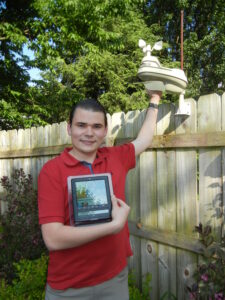
Perched on a fence that straddles a tiny garden and an equally tidy alley in Woodsdale is a small weather station operated by Michael Borsuk, a rising sophomore on a pre-law track at Marshall University.
"I just like knowing," said Borsuk, who recently resurrected a small station he purchased for $150 back in 2017.
The station collects data on wind speed, rainfall, barometric pressure, humidity and temperature -- the same parameters that are more officially monitored for the National Weather Service (NWS) and television meteorologists at the airport.
"This all started when I was in Scouts," said Borsuk, who rose to the rank of Eagle Scout. "We had to forecast the weather."
That activity turned into a bit of a quest for Borsuk, whose dad is a Ph.D.-level scientist for the U.S. Environmental Protection Agency. He realized he had enough backyard data -- at least in theory -- to forecast about 48 hours into the future.
Borsuk was hooked. "I sort of came up with a game -- how right the TV was compared to my backyard forecasting."
At one point, he said his station was linked with about 7,000 others worldwide to the NWS through the service's Citizen Weather Observer Program. Maintaining a dedicated internet connection with data drops required every 15 minutes turned out to be more than he wanted to mess with as a teen.
He maintained his certification as a weather spotter, however. That ongoing connection has been more than theoretical.
When a derecho hit Wheeling in 2017, Borsuk's station recorded the 3 inches of rainfall that fell within 30 minutes and he reported that data to the NWS. The storm flooded numerous properties in the blocks around the family home.
He continues to report to a dedicated phone line at the NWS's Pittsburgh office if he sees looming problems such as flood water creeping onto a road or a stream breaching its banks.
DATA NETWORK
While Borsuk said his station and general weather watchfulness are about being "an armchair meteorologist," more of the same kind of monitoring is popping up all over the Ohio Valley in a roadblock and flashing-red-lights kind of way.
The last few of a dozen small weather stations purchased by the Belmont County Emergency Management Agency are set to go online in the next couple of weeks, according to agency Director Dave Ivan.
They are located on buildings, telephone poles and at least one antennae tower -- places he said they are able to tap into Wi-Fi.
"We've got them everywhere -- from Yorkville to Powhatan," Ivan said. "One of the reasons we decided to go this route is we get hit with flash flooding."
The county previously had some rain gauges, but the new stations are higher end and more broadly distributed, he noted.
"We can sit here and look at radar," Ivan said of the past. "But, we don't know what the actual rain amount is."
Now, if a station at Colerain or Wolfhurst is getting deluged, Ivan said the agency has an idea of what streams need to be monitored and how quickly. And, the NWS -- to which all of the solar-powered units will continually report -- can better understand what might be headed to nearby communities.
Ivan said the agency's stations -- which were purchased with a pot of funding associated with their response to an emergency at a gas and oil pad -- are technological wonders.
"There are no moving parts," but they monitor all the parameters the NWS needs and can tell the difference between driving rain and, say, an occasional bird resting atop part of the station. "These are pretty sophisticated pieces of equipment."
Already, the stations are tapped into an online weather database called Tempestfx.com. He noted that a mere two weeks after that connection was made agency staffers were checking out readings from similar stations and could see in real time when 16 inches of rain hit Florida in a 24 hour period.
It was a moment that sobers him even though a dry spell is hovering over the Ohio Valley at present and Ivan said there hasn't been a whole lot for the stations to monitor. Not much going on in terms of backyard weather is A-OK with him.
"You always hope nothing's going to happen," he said. "But, this gives us a chance to be proactive."