
Everywhere a Chick, Chick
Trending
WEST LIBERTY -- It's 28 degrees, dusk is looming and the wind is whipping viciously across the pasture.
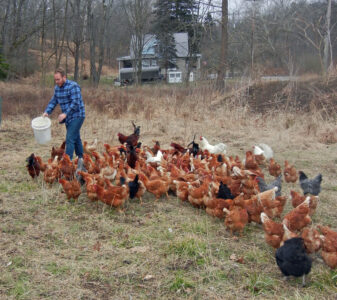
But, the chickens are murmuring with excitement. It's feeding time and they are suddenly a sea of russet feathers around farmer Eric Blend's feet.
He's got the locally milled mix of corn, soybeans and minerals that fuels their inner flames.
Brianna Blend, meanwhile, is expertly collecting eggs from a series of hoppers at one end of the rolling coop where some 150 red sex link hens and seven roosters will soon snuggle up against the weather. Her hands move at lightning speed, shifting eggs from the hoppers into a wire basket. There are 75 when she's done -- not a bad day's collection given the fierce weather.
HERE A CHICK
The smooth, brown miracles were headed to area restaurants and to a cooler at the Public Market in downtown Wheeling. At the latter, they will be sold for $6 a dozen, or 50 cents per nutrient-packed egg, Eric Blend said.
It's a price that reflects the cost of 400 pounds of feed a week and raising chickens in a way that keeps them pecking and scratching at grass and feeling both wild winds and breezes ruffling their feathers, Blend explained.
He said it's not about the skyrocketing egg values connected to the avian influenza outbreak -- which the U.S. Centers for Disease Control records as having afflicted 58 million chickens nationally as of mid-February.
It's not about the global commodities market, either, he added.
"What happens in Ukraine doesn't affect John Miller up in Brooke County when he grows the corn and dries it and sells it to Dale (Sampson Feed of West Liberty)," Blend said. "Small businesses kind of ride the waves."
That ultra-local loop -- farm to feed mill to farm to table -- is something Blend believes is important to regional food supply. He's putting a lot behind the sentiment.
In addition to working full time for the state Department of Environmental Protection, Blend and wife Brianna Blend, a full-time teacher, now maintain a multi-faceted farm.
Initially, their farming was entirely on leased land. But the couple recently purchased 40 acres just outside West Liberty to be their Blended Homestead.
"I put up my first permanent fence last month," Blend said of moving their entire operation -- which includes the egg-laying flock, about 1,000 meat chickens, eight pigs, eight hives of honey bees and seasonal produce -- to their new land. They are also building a house there and raising their 8-month-old baby.
It's personal, Blend said of why he's willing to add agriculture onto an already busy life. "I was just frustrated by what I was getting from the stores," he said of what began as a search for farm-fresh flavor.
He's also committed to earth- and animal-friendly practices. These include maintaining a negative carbon footprint by using such techniques as portable, solar-powered fencing and natural springs. The operation also features a rolling coop with a mesh floor so that his flocks rotate across pasture land - naturally fertilizing a broad area rather than fouling a small one.
"Our chickens live on grass their entire lives ... Our address of our house is on our egg cartons," he said, further contrasting small farms such as his own with some of the massive-scale producers that have taken the numerically-hardest hit of the avian influenza outbreak.
Not to say that the illness - which is spread by wild birds who have no symptoms - couldn't make it into local chickens. The Blends said they have pursued training specific to the outbreak and take general precautions that range from not accepting giveaway birds into their flocks to scheduling farm chores in an order that reduces the risk of contamination.
So far this year, there have not been any documented cases of bird flu in commercial farms or backyard flocks in West Virginia, according to Karen Cox, West Virginia University extension agent for Ohio County. But, the disease isn't far away. As of mid-February, she said the unfolding outbreak has been recently detected in 19 states - including Ohio, Pennsylvania and Virginia.
Blend said his more likely nemesis since Blended Homestead began egg production in 2016 has been raccoons rather than disease. In 2022, he said, three raccoons breached the fence and killed half of his flock. The other half was so traumatized they stopped laying eggs for a time.
"It's been a heck of a ride," Blend said of his overall farming experience. "But, I've learned a lot."
THERE A CHICK
Dale Sampson - the West Liberty-based supplier who mills Blended Homestead's chicken feed - said that learning curve is looping in a surprising number of new people.
"I ordered 300 baby chicks last week," Sampson said of an uptick in demand he believes is connected to both the increase in egg prices and a growing local food movement. "They're all sold. These are meat chicks."
Sampson has operated his feed store for 62 years and said he has, "seen a good bit come and go." He noted the supply-and-demand nature of the agricultural economy and said he suspects eggs prices will drop notably by summer. It takes about 26 weeks for hens to reach laying weight, he explained of it taking a while for large-scale commercial producers to gear back up with new flocks.
Smaller-scale producers such as Blended Homestead and, more so, individuals with a backyard flock are a different animal, he added.
"The home-raised clucks - most people become attached to them and they consider them pets," he said of people keeping their hens after their peak initial year of egg laying has passed. "They keep them until they're three, four years old."
Cox, from the Ohio County Extension Office, cautioned would-be egg or chicken-meat raisers to learn all they can before adding farm animals to their lives, however. The WVU Extension Service has more information on backyard flock management online. And, she noted, the city of Wheeling requires a waiver for chickens living within the city limits.
In addition to the online resources, she encouraged new backyard-flock enthusiasts to reach out to her office. She added that chickens can make a great 4-H project for children age 9 and older.
Sampson said he gets the need for information and believes it's worth the effort. "Being able to say, 'I raised this or grew this.' It's nice," he said. The supply-chain issue or the moment just adds a layer of reality, he added.
"They're concerned. They need to be," he said of his new crop of backyard farmers. "You've got to have something to eat every day. A lot of other things in life aren't as necessary."
###