
Vincent DeGeorge is Getting His Hands Dirty To Tap Into Wheeling’s Potential
Trending
By SHELLEY HANSON
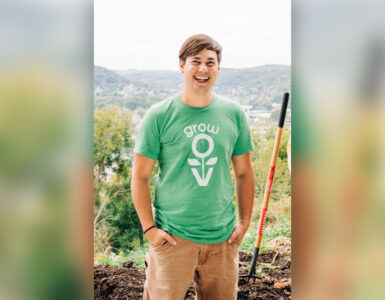
WHEELING - Vincent DeGeorge, 34, has lived and worked in a few different cities, but he decided to make Wheeling his home because of its problems and its potential.
DeGeorge is director of operations for Grow Ohio Valley and is also the organization's Wheeling Food Hub project lead. He has worked with the non-profit since 2018.
DeGeorge grew up in Morgantown, but spent time in Cleveland, Pittsburgh, Los Angeles and Washington, D.C. before coming back home to West Virginia.
A typical day with Grow OV, he said, includes "weekly check-ins with our teams, grant writing and reporting, partner calls, even GrowOV/Wheeling tours have become regular."
"And then there are the exciting one-off things, especially for our start-up projects, that are the most fun to me: meeting with new contractors, architects or engineers for the Wheeling Food Hub project, developing new food system or regional partnerships, and then also hands-on things like operating boom lift last month, or getting pulled into our 'all hands' farm efforts like the hay or potato harvest, or even our Harvest Festival," he said.
"Also I can't walk into the Public Market or around East Wheeling without talking to our neighbors and friends, and that's very special."
DeGeorge said what attracted him to the Ohio Valley was opportunity.
"Wheeling is almost raw opportunity. Wheeling, West Virginia, and Appalachia have our problems/needs - that we all know and talk about - but we also have tremendous opportunities," he said.
"We've got to work hard, maybe get creative and get our hands dirty to tap into it, but it's here.
"The Weelunk 'Do Something!' spirit - from GrowOV, to House of Hagar and Mother Jones House, to re-doing a house, to starting a great new business like East Wheeling Clayworks or any of our great new restaurants - Wheeling is the place to do something," he said.
DeGeorge believes Wheeling's bright spot is its history and potential.
"This is ground zero; I tell people that 'Wheeling is the actual center of the universe' because things happen here," he said. "The coal and steel that built the country is from here. The Energy Transition will continue playing out here.
"Our teachers started the national teachers movement here. The tie-breaking vote in the U.S. Senate is from here. Trump comes to speak here.
"Tom Breiding likes to quote, 'You can't understand America without understanding Appalachia,' and I like to add, if you can solve Wheeling, or West Virginia, or Appalachia's problems, then we've solved a big chunk of America's problems.
"What we're facing here isn't unique, it's not by accident, and as long as we keep leaning in and refuse to give up on addressing our needs, eventually we'll keep making progress towards sustainable change."
DeGeorge believes the future of his field, non-profts, is developing good partnerships.
"The nonprofits and non-profit partners in this area and larger region are really leaning into this and I think it is full of potential," he said.
"We can increase our impact, and make real progress addressing our needs and making an impact by getting out of our silos, competing less and collaborating more, and overall working together.
"The Ohio County Food Security group, and Soup Kitchen-Wheeling Health Right's joint fundraiser are great examples."
DeGeorge said a valuable lesson he has learned is that people accomplish more together than alone.
"I really learned that lesson well at Carnegie Mellon from my advisor," he said. "Science is very collaborative, but I think the lesson transfers.
"I wouldn't have been able to do my research, publish, get patents, heck even get my PhD and all that goes with that without really trusting in my advisor, and team and partners.
"Find a good team, trust them, and then do great things. We can choose what - and where - we contribute.
"I learned that when I was working in research and development in aerospace in Los Angeles and decided to come back to West Virginia."
For those just entering the workforce, DeGeorge recommends that they "jump in, work hard, don't get bogged down by, or in, negativity."
"West Virginians can do it. That self doubt, 'why should I bother,' 'Appalachian fatalism' is real," he said. "Feel it. Own it. And then spit it out.
"We can get our PhD's or GED's, start our ground-breaking non-profits or businesses, run for office or make an impact, just as well as anyone. So let's do it."
A philosophy that DeGeorge lives by is, "Let's make a world where it is easier to do good."
"That's a saying that bounces around Catholic Worker circles; I lived at the House of Hagar for the first three years I was in Wheeling," he said.
"I think it speaks to both simplifying things in a complex world, while also keeping first things first, i.e. doing good."
DeGeorge said in his professional life he most proud of Grow OV and what it has accomplished to date. It is an "exciting, dynamic, Silicon Valley-esque start-up" in Wheeling, he said.
"I've contributed to urban farming, West Virginia's first FARMacy programs, starting a grocery store that eliminated three USDA-classified 'food deserts', bringing somewhere between $4 million and $7 million to the valley, feeding our way through the pandemic as a community - you name it," he said.
"I want to help keep that going for our community and state, especially for young, talented people who normally might have to look elsewhere to find that."
DeGeorge said he and most of the Grow OV members started out as volunteers in their spare time or as Americorps members.
"If you are interested in local food, agriculture, or just community service feel free to volunteer with us, or refer people to us," he said. "We're accepting Americorps applications now."
DeGeorge has served on the Wheeling Human Rights Commission in the past, along with volunteering at the House of Hagar. He also has also served with the Lions Club and Ohio County Solid Waste Authority.