
Who’s Next on the List: A Look at the Next Weeks and Months Rolling Out COVID-19 Vaccine
Trending
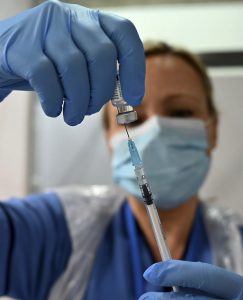
WHEELING -- While front-line health care workers are scheduled to receive the first of the first wave of COVID-19 vaccines -- as the Food and Drug Administration approved the Pfizer vaccine Friday night -- it's an open question as to what order the rest of society will be inoculated against the disease.
Wheeling-Ohio County Health Administrator Howard Gamble said the exact order of who to roll the vaccine to is a joint matter up for consideration between the West Virginia Department of Health and Human Resources and the state medical system.
The rollout is divided into two phases, and the bleeding edge of Phase One concerns frontline workers: those working in emergency rooms, intensive care units, and -- if hospitals have one -- dedicated COVID wings.
Within those groups, priority will be determined among those with the most risk of exposure, with consideration given to how many doses of vaccine are available.
After that point, other health care workers are scheduled to receive the vaccine, including workers and residents at long-term care facilities, constituting the bulk of Phase One.
"You won't be able to do everybody, at some of our larger facilities, our Wheeling (Hospital), our (J.W.) Ruby (Memorial Hospital), so on, then we'll broaden it within the facility to maybe include anaesthesia, other areas where they're using the personnel in the hospital for the regular, routine business of COVID. You might broaden it to those who have a lot of contact (with people) such as storage, or security," he said.
Gamble said the vaccines available to long-term care residents and workers would come closely behind the frontline workers, within a matter of days — as long as the supply chain remains strong. According to Gov. Jim Justice on Monday, the state submitted an initial order for 16,575 doses of the vaccine developed by Pfizer, with additional orders to total 60,000 doses in the initial allocation. An additional 20,000 more doses of another vaccine, manufactured by Moderna, are to arrive shortly after.
"Anything could happen on a supply chain. We're going to have vaccines come in quick, in small quantities," he added.
Following those in health care and long-term care, Gamble said, those in "critical infrastructure" will continue Phase One, including those who staff mass testing clinics and first responders, such as firefighters, police and emergency medical service personnel.
Gamble said prison populations will come "a little later," clarifying that "a little" meant a week or a week and a half, and inoculation efforts would focus on guards and other personnel who interact with inmates, rather than administrative staff.
"As they're vaccinated, that group, then, being somewhat protected with the one dose, begins the vaccination of the population."
Gamble was unable to say how many doses would be distributed at any given time, but the difficulties of transport and storage of the vaccine, which requires "ultra-cold" temperatures, means that people who miss their appointments will see that shot go to another facility to be used, rather than go to waste.
"Some of these vaccines are a component-based vaccine," Gamble said. "You have a sterile component, like sterile water, and if you put it together, you need to vaccinate. In the county, we're beginning to think, can we put a small list together that, if four or five people don't show up or decline, we can say, 'Can you be here in 15 minutes before the office closes and get your shot?' ... It's not for the general public, it's trying to wrap up that first phase of who needs it very quickly."
Registration to receive the vaccine, Gamble said, would be conducted entirely through the Centers for Disease Control's online Vaccine Administration Management Systems. Gamble said the use of VAMS will be a learning experience.
"The initial doses, whether it's hospitals, nursing homes, or first responders, those numbers have already been determined," he said. "It's going to be a learning curve to try to use this very clinical-based registration system for public health. Typically, we just get a vaccine and we start announcing groups to come, but they want to control a lot of the data."
Rounding out the first phase will be educators, which Gamble specified as the faculty and staff of K-12 schooling and higher education.
Phase Two of the rollout involves mass immunization clinics held throughout communities, which may be initially based on targeted populations. At certain locations and times, those fitting certain criteria may come and register and receive their vaccinations.
Drawing from experience with previous mass vaccinations with the H1N1 (commonly known as swine flu) pandemic of 2009, Gamble said the clinics will be limited by the number of available vaccines, with only so many doses available.
Following the mass vaccinations, which Gamble said are expected to last into February or March, he expects that we will see versions of the COVID vaccine readily available at doctor's offices and pharmacies for the general public, which do not need to be kept in extremely cold environments.
"Mass vaccinations will last a long time — we're looking into spring," he said. "Past that, we're ... into a more routine, general vaccination program. ... The vaccine's more readily available, and is a product that can be held at a doctor's office or pharmacy safely."
Gamble said by March, the country could have as many as four vaccines available, greatly increasing the supply and reducing pressure on supply chains.
"We've vaccinated the masses, the healthcare industry, the public health and safety programs, we've mass-vaccinated as many as we can, but we have to continue the momentum of keeping the disease at a controlled level, hence the routine vaccines. Maybe by then it's more stable."
Gamble said most counties will require sign-ups and registration for the mass vaccination clinics, in order to not waste doses or have people stand in line and not receive them. He added that the county is still testing, and will continue to test, for COVID-19 through the vaccination phases to ensure those who receive the vaccine react properly to it.
In Belmont county, the first round of COVID-19 vaccine is expected to arrive Dec. 22, but the precise plan for administering the shots to the public remains somewhat unclear.
Rob Sproul, deputy commissioner of the Belmont County Health Department, said it has been established that hospital workers, nursing home staff and residents and assisted living employees will be first in line for the vaccine. Beyond that, he said, much remains to be determined.
"The shot is voluntary, not mandatory," he added, noting he does not yet know if local hospitals will require their employees to receive the vaccine. He said they do require staff to be vaccinated against influenza.
Sproul said Belmont County would receive the Moderna vaccine, rather than the Pfizer vaccine that requires ultra-cold storage. He said Belmont County does not have facilities to properly store the Pfizer vaccine. The Moderna vaccine is next in line for approval and does not have to be stored at such low temperatures. Local West Virginia counties will receive the Pfizer vaccine, as will some Ohio cities such as Columbus and Cleveland.
A second round of shots is expected to go to paramedics and emergency medical technicians as well as some health department staff. Sproul said, based on his experience with H1N1, health department nurses who administer the vaccine and interact with patients likely will receive the vaccine in this round, but he and other non-medical staff members probably will not.
He added it is unclear when some home health and nursing facility employees will be vaccinated. He said those associated with hospitals might get shots sooner than those that are not.
Martins Ferry Times-Leader managing editor Jennifer Compston-Strough contributed to this report.